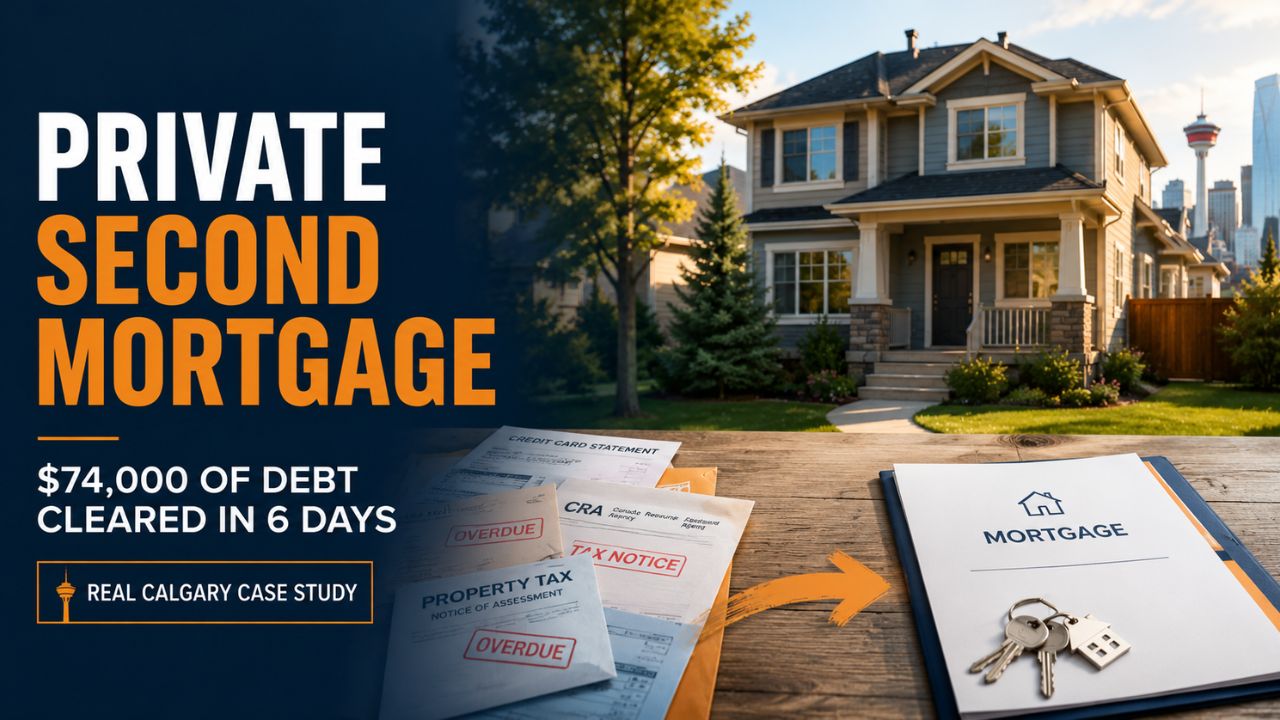
Private Second Mortgage in Calgary: $74,000 of Debt Cleared in One Week (Real Case Study)
When Dave and Karen* called, they weren’t shopping for a rate. They were six days away from signing something that would have cost them a great deal more — because it was the only offer they had, and the clock had run out.
Their mortgage was perfect. Not a single late payment in years. What had come apart was everything around the mortgage: about $38,000 spread across six credit cards, a $24,000 secured line registered against the house, roughly $8,600 owed to the Canada Revenue Agency, and the year’s property taxes coming due at the end of the month. One partner had been out of work for close to two years. The household was running on one steady, long-tenured income, and it was no longer enough to hold the line.
They already had a rescue offer in hand from a well-known equity lender: 13.75%, with roughly $12,000 in fees. They were being pushed to sign it. This is the story of what we did instead, in six days — and, more importantly, why the loan we wrote was deliberately built so they could walk away from it the moment they no longer needed it. Names and identifying details have been changed, but the numbers and the sequence are real.
The problem was never the mortgage
This is the part almost everyone gets backwards. When someone calls us buried in debt, the assumption is that the house is the problem. Here it was the opposite: the mortgage was the one thing that had gone right. It was current, it had never been late, there were no arrears and no foreclosure — and the home had an appraisal completed days earlier putting it at $500,000. (The city’s tax assessment was higher still, at $558,000. We underwrote to the lower, appraised number.)
That clean mortgage history turned out to be the single most valuable thing they owned, and they didn’t know it. Credit scores were bruised — 574 and 616 — but the damage was almost entirely from maxed-out revolving balances, not from missed payments. That distinction matters enormously to a lender, and it’s the reason the road back was going to be short.
“We’re a risk. We’re a dangerous pile of whatever we are. We’re not bad people. We’re just stuck.”
What was closing in wasn’t the bank. It was everything else. Collectors were calling. Bills were going unpaid in a specific, frightening order — and in their own words on that first call, the credit cards and the household bills were about to be shut off. The CRA debt was the quiet danger: unpaid tax debt can end up registered as a lien against your home, and once that happens the options narrow fast.
There was a cheaper answer. It would have taken weeks they didn’t have.
On the first call we walked through three routes, honestly, including the one that would have cost them the least.
| Route | Cost | Realistic timeline |
|---|---|---|
| Refinance everything into one new first mortgage with an alternative lender | Cheapest by far — one lower rate, no lender fee | Weeks. Full underwrite, appraisal, income story |
| Alternative-lender refinance of the existing mortgage | Middle | Weeks |
| Private second mortgage behind the existing first | Most expensive per year — but nothing else moves this fast | Days |
The cheapest option was real, and we said so. With one borrower out of work, a full refinance meant a complete underwrite and an income story that would take weeks to assemble — weeks the family did not have.
So we didn’t pick one. We staged them. Phase one stops the bleeding right now with expensive money. Phase two, once the dust settles and the credit recovers, replaces that expensive money with the cheap solution that was always the right long-term answer. The trick is making absolutely certain phase one can’t trap you — which is the whole point of what follows.
What the $100,000 actually did
We placed a $100,000 private second mortgage behind the existing first: 10% fixed, interest-only at $833.33 a month, on a 12-month term. With the first mortgage at roughly $225,000 and the new second at $100,000 against a $500,000 appraised value, the combined loan-to-value came in at 65% — comfortable enough for a private lender to move quickly.
| What it took care of | Amount |
|---|---|
| Six credit cards — paid to zero | ~$38,000 |
| The secured line registered against the home — paid out and cleared off title | ~$24,100 |
| Canada Revenue Agency arrears — cleared before a lien could be registered | ~$8,600 |
| The year’s property taxes, paid in advance by the lawyer at closing | ~$3,200 |
| Lender fee, broker fee, legal and land titles | $10,000 |
| Left over — paid directly to the family | ~$16,000 |
| Private second mortgage | $100,000 |
Figures are rounded. After the $10,000 in fees came off the top, $90,000 in net proceeds went out through the lawyer’s trust account — about $74,000 to debts, arrears and taxes, and roughly $16,000 back to the family for breathing room, insurance and a cushion.
The part that matters most: the exit was built in on day one
Here is where a rescue loan either saves a family or swallows them. Expensive short-term money is a perfectly good tool — as long as you can put it down. Far too many private second mortgages are written so that leaving early is punished: three months’ interest penalty, a discharge fee, a bonus clause, a closed term. A family fixes the emergency and then discovers the fix has become the new problem.
So the commitment they signed said this, in plain language:
Prepayment: This mortgage is open to repayment with no penalty.
Not open after three months. Not open with a fee. Open from the first day, for the full twelve months. They can refinance it, pay it out, or replace it at any point, on any day, and it costs them nothing to do so.
That single clause is what turns this from a debt trap into a runway. The expensive money is only expensive for as long as they need it — and every month their credit recovers is a month closer to not needing it.
“Let’s figure out a way to get you out of it in under a year. And we’ll make it so the mortgage is open, so there’s no penalty when you break out of it.”
One honest footnote, because it cuts the other way and you deserve to know it: the commitment does carry a renewal fee of 1% if the mortgage is still there in twelve months and has to be renewed. That is a cost of staying, not a cost of leaving — and it’s deliberate. Everything about this structure is designed to push the family out of it, not to keep them in it.
Being straight about what this cost
We’re not going to dress this up. A $100,000 private second at 10% interest, with $10,000 of fees amortised over a single twelve-month term, works out to an annual percentage rate of about 20% and a total cost of credit near $20,000 for the year. That is expensive money, and it should only ever be borrowed with an exit already written down.
It was still materially better than the alternative in front of them — a lower interest rate, lower fees, and, critically, a term they could get out of for free. And it was better than the thing that was actually going to happen if nobody moved: cards shut off, a possible CRA lien, and a tax bill going into arrears on top of everything else.
Keeping one card each — on purpose
Most debt consolidations close every card. We didn’t. Four cards were paid off and closed; two were paid to zero and deliberately kept open with reduced limits — one for each of them.
That’s not sentiment, it’s strategy. Credit scores are built on active, well-managed tradelines. Close every account and you paper over the damage while quietly removing the tools you need to repair it. Two live cards, near-zero balances, small limits, paid in full every month, is one of the fastest legitimate ways to rebuild a score — and rebuilding those scores is precisely what unlocks the cheap refinance in phase two.
Two small student loans were left alone as well: low balances, low payments, and years of clean history sitting on the credit file. There was nothing to gain by touching them.
The monthly picture, before and after
| Monthly obligations | Before | After |
|---|---|---|
| First mortgage (unchanged throughout) | ~$1,310 | ~$1,310 |
| Minimum payments across six cards and the secured line | ~$1,470 | $0 |
| Private second mortgage — interest only | — | $833 |
| Total out the door each month | ~$2,780 | ~$2,145 |
Approximate, and based on the minimum payments documented on the file. Roughly $600 a month freed up — while about $74,000 of debt, arrears and taxes disappeared entirely, and around $16,000 went back into the family’s pocket.
Stop the bleeding — fast
A $100,000 private second mortgage at 10%, interest-only, arranged in six days. It cleared roughly $74,000 of cards, a secured line, CRA arrears and the year’s property taxes, and put about $16,000 back in their hands.
Rebuild the credit deliberately
Utilisation drops to near zero overnight. Two cards stay open with small limits to rebuild active history. The first mortgage keeps its perfect payment record. Every month makes the next lender more comfortable.
Replace the expensive money
In roughly six months, refinance the first mortgage and the private second into one clean mortgage at a normal rate — possible at any time, at no cost, because the second is fully open. That’s the whole reason it was written that way.
What happens next
This is a two-part story and we’re publishing part one before part two exists, on purpose. The exit is booked in our calendar, not left to memory — a scheduled check-in to start assembling the refinance well before the twelve months are up.
Because the mortgage payment history stayed spotless throughout, there’s a real possibility this family skips the alternative-lender step entirely and goes straight back to a mainstream lender. That was always the target. When it funds, we’ll publish part two with the same file, the same numbers, and the exit executed — whatever it actually turns out to be.
Could a private second mortgage work for you?
It is the right tool in a narrow set of circumstances, and the wrong one in most others. It tends to fit when:
- You have meaningful equity in your home — typically enough to keep total borrowing at or under about 75–80% of its value.
- Your mortgage payment history is clean, even if your credit score isn’t. That history is what makes the way back short.
- You need money in days, not weeks — collectors, arrears, a tax bill, a lien threat, a closing deadline.
- There is a credible exit: a realistic path back to a normal lender within six to twelve months.
- The term is genuinely open, so taking that exit costs you nothing.
If the last two aren’t true, a private second mortgage is usually the wrong answer — and we’ll tell you so.
★ 5.0 · 292+ Google reviews
What Alberta homeowners say
Really good experience with the Mortages for Less Team. Tamar was very attentive to our needs.
Tamar was great to deal with. Efficiently got me everything I needed... And more. Thanks Tamar
Josh provided me with good advice and did not waste my time.
Easy to approach.understanding and very professional.
Didn’t end up getting a mortgage through him but Josh was incredibly helpful and provided objective advice.
Tamar is truly amazing and so patient. She helped us through the entire process (which was quite confusing to be honest). Highly recommend.
I recently used their service, Tamar was my broker and she did a great job. She solved all our doubts and gave us the best service.
Tamar was super helpful throughout the process of helping us renew our mortgage. We changed mortgage providers, but Tamar made the process smooth.
Drowning in debt but sitting on equity? Let’s run your numbers.
Collectors calling, tax arrears, cards at their limit — if there’s equity in your home there is often a way to fix it quickly, and a way back to a normal mortgage afterwards. Start a confidential conversation and we’ll map out the options and the timing for your situation.
Apply Online → Book a Discovery Call → Serving Calgary, Edmonton & all of Alberta · Mortgages for Less with INDI MortgagePrivate second mortgages and debt consolidation: common questions
What is a private second mortgage?
How fast can a private second mortgage actually fund?
Can I get a second mortgage with bad credit?
What does a private second mortgage cost?
What does “fully open” mean, and why does it matter so much?
Can a second mortgage pay off CRA tax debt?
Should I close all my credit cards after consolidating?
How do I get out of a private second mortgage later?
I’m in Edmonton or a smaller Alberta town — can you still help?
*Names and identifying details have been changed to protect client privacy. This case study is based on a real client file; the dollar figures, rates and credit scores reflect that file and are provided for illustration only, with several amounts approximate or rounded. This mortgage was funded through a private lender we work with closely; the nature of that relationship was disclosed in writing and acknowledged in signing by the borrowers before funding, as required. Every mortgage situation is different — equity, credit, qualification, timing, costs and results vary by individual and by lender, and are subject to change and to lender approval. Nothing here is a promise or prediction of outcome. Private mortgages carry substantially higher rates and fees than mainstream mortgages and are intended as short-term solutions only. This article is general information, not financial, mortgage, tax or legal advice. Please speak with a licensed mortgage professional about your specific circumstances. Mortgages for Less with INDI Mortgage.