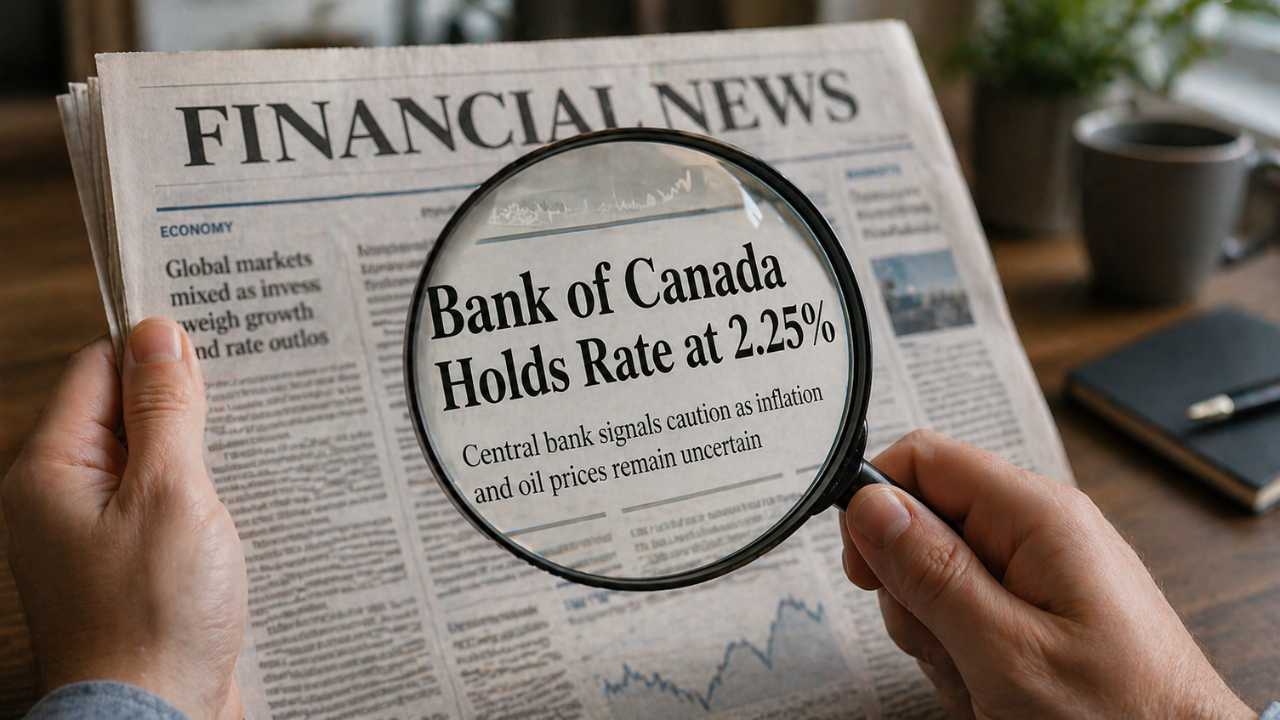
As expected, the Bank of Canada decided to hold their policy rate at 2.25%. But what matters more is what they said about where things could go next.
As a mortgage broker here in Alberta, I’ll tell you what that means for you.
Why did the Bank of Canada hold rates?

Right now, the inflation rate is sitting close to the Bank’s 2% target, and the core measures they watch closely are also trending in the right direction. That gives them room to pause and not rush into any changes.
At the same time, the economy is slowing a bit. Consumers are being more cautious, borrowing is tighter, and overall demand has cooled compared to the past few years.
Put those together, and a rate hold makes sense.
Why do oil prices and economic growth matter so much here?
Here in Alberta, this part matters more than most places in Canada.
One of the big themes coming out of this announcement is that stronger economic growth and higher oil prices could push inflation back up. And if that happens, the Bank has made it clear they are willing to raise rates again.
Higher oil prices can boost Alberta’s economy, which is great for jobs and income. But it can also lead to higher inflation, especially if that strength spreads across the country.
That’s the balancing act we’re in right now.
What does a hold mean for variable mortgage rates?
If you have a variable rate mortgage, nothing changes immediately. Your rate is tied to the Bank of Canada’s policy rate, and since they held steady, your payments stay the same for now.
But this announcement is clearly saying that hikes are still on the table if inflation picks back up. So if you’re in a variable rate, this is a “wait and watch” environment.
What’s happening with fixed mortgage rates?
Fixed rates are a bit different.
They’re driven more by bond yields than the Bank of Canada directly. And lately, bond yields have been moving around based on global uncertainty, inflation expectations, and economic data.
That means fixed rates can move even when the Bank holds.
Right now, we’re seeing some stability, but also some volatility under the surface. It wouldn’t take much for fixed rates to move up or down depending on what happens next with inflation and the global economy.
What am I telling my clients right now?

I’ve said it over and over and I’ll keep saying it: strategies are more important than predictions.
If you’re still trying to time the market or waiting for rates to drop before making a move, you’re doing yourself a disservice. No one knows exactly what will happen — or when.
Here’s what I’m advising instead:
- If you’re buying a home, get pre-approved and secure a rate hold. That protects you if rates go up while you’re shopping.
- If your mortgage is renewing in the next 6 to 12 months, start planning now. Don’t wait for your lender’s renewal letter and assume it’s your best option.
- If you’re in a variable rate, make sure you’re comfortable with some uncertainty. There’s still a real chance rates stay higher for longer than people expected earlier this year.
What’s your next step?
This rate hold is not a signal that everything is about to get cheaper. It’s a signal that the Bank of Canada is being cautious and data-driven. They’re watching inflation, growth, and especially factors like oil prices very closely.
For Alberta homeowners and buyers, that means we’re still in a market where preparation make a bigger difference than trying to guess the next move.
If you want to talk through your situation and what strategy makes the most sense for you, I’m always happy to help you map it out. Reach out and book a call with me.
How an Alberta mortgage broker helps when rates are on hold
A hold isn’t a reason to do nothing. Here’s what we actually work on in a “wait and watch” stretch:
- We get you pre-approved with a rate hold so a move in fixed rates while you’re house-hunting doesn’t change what you can buy.
- We start renewals 6 to 12 months out, instead of reacting to the lender’s letter when your options have narrowed to one.
- We pressure-test whether a variable rate still fits you if the Bank follows through on the possibility of hiking again.
- We watch bond yields, not just the policy rate, because that’s what actually moves the fixed rate you’ll be offered.
- We factor in what Alberta’s oil-linked economy means for your income stability, not just for the national inflation number.
- We build a strategy that works in more than one rate scenario, so you’re not depending on a forecast being right.
Want a strategy instead of a prediction?
Let’s look at your purchase, renewal or variable-rate mortgage and map out what makes sense whether rates hold, fall or move back up.
Apply Online → Book a Discovery Call → Serving Calgary, Edmonton & all of Alberta · Mortgages for Less with INDI MortgageThe Bank of Canada hold: common questions
What did the Bank of Canada do with its policy rate?
Why did the Bank hold rates instead of cutting?
Could the Bank of Canada raise rates again?
Does a rate hold change my variable-rate mortgage?
Why can fixed mortgage rates move when the Bank holds?
What should I do if I’m buying a home right now?
My mortgage renews soon — when should I start planning?
This article reflects the Bank of Canada announcement of April 29, 2026 and is general information for Alberta homeowners and homebuyers, not financial, mortgage, tax or investment advice. Policy rates, bond yields and lender pricing change frequently, and any mortgage is subject to lender approval. Please speak with a licensed mortgage professional about your specific circumstances. Mortgages for Less with INDI Mortgage.