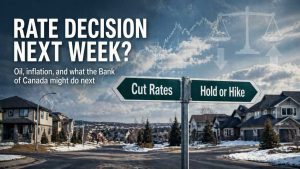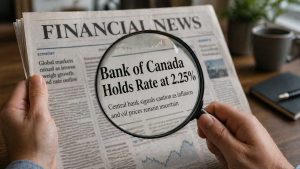
A lot of my posts lately have been about mortgage rates. Tomorrow the Bank of Canada is making their rate announcement, which impacts variable mortgage rates. I’m a mortgage broker in Alberta and here’s what I expect is going to happen.
Why is the Bank of Canada likely to hold rates?

Going into this week’s Bank of Canada announcement, a rate hold looks very likely.
Inflation is still under control overall. Canada’s Consumer Price Index recently came in at 2.4%, which is below expectations. Even more important, the Bank’s preferred core inflation measures are sitting close to 2% and trending lower when you look at recent months.
At the same time, we’re seeing a spike in global energy prices. Normally, that would push inflation higher, but so far it hasn’t fully filtered through the broader economy. There are a few reasons for that.
Economic growth is slowing. Consumers and businesses are more cautious, and spending has softened. Lending conditions are tighter, which is also cooling demand. Even shelter costs, which were a major driver of inflation over the past few years, are now easing.
Higher energy costs are also acting like a brake on the economy. When people spend more on fuel and heating, they have less money for everything else.
Put it all together, and it gives the Bank of Canada a reason to wait rather than react too quickly.
Are rate cuts still on the table?
Even though rates are likely holding for now, I still believe the next move from the Bank of Canada will be a cut, not a hike.
Earlier this year, markets were expecting multiple rate increases. That thinking has shifted. Investors are no longer pricing in hikes for 2026, and that’s a big change.
The reason: slowing inflation, like weaker demand and tighter credit, tend to last longer than short-term spikes in oil prices. Unless energy-driven inflation becomes widespread and persistent, the Bank will likely look through it.
That said, there is still uncertainty. A lot depends on global events, including how long geopolitical tensions last and whether energy markets stabilize.
What is driving fixed mortgage rates right now?

Fixed mortgage rates are being driven by Government of Canada bond yields, and lately those yields have been moving around without a clear direction. That’s why fixed rates have been holding steady overall.
If you’re considering a fixed rate right now, you should be prepared for some short-term volatility. Rates can move quickly when bond markets react to new economic data or global news.
When I’m working with clients, the most common choice continues to be between a three-year and a five-year fixed rate. If the pricing between those two options is close, I generally think the five-year offers better value. It gives you longer-term stability and protects you if rates stay higher for longer than expected.
Are variable mortgage rates becoming more attractive?
Variable rates haven’t changed much recently, but the gap between fixed and variable is starting to widen again. As fixed rates feel pressure from rising bond yields, variable rates are becoming more attractive from a cost perspective.
My current view is that variable rates are still likely to deliver the lowest total borrowing cost over a five-year period. But there’s a trade-off.
Variable rates come with uncertainty. Payments or costs can change, and we’ve already seen how quickly things can shift when global events impact inflation expectations. If you’re considering a variable rate, you need to be comfortable with that risk and have room in your budget to handle higher costs if they come.
What am I telling my clients right now?
Most of the clients I’m working with today are choosing fixed rates, and I understand why. There’s a lot of uncertainty in the world right now, and fixed rates offer peace of mind. You know exactly what your payment will be, and that stability matters.
At the same time, I’m still having plenty of conversations about variable rates, especially with clients who have flexibility in their budget and are thinking longer term.
If you value certainty and want to remove risk, fixed rates are a strong option. If you’re comfortable riding out some ups and downs in exchange for potential savings, a variable rate can still make sense. Here’s another post about how to choose between the two.
What does all of this mean for Alberta homebuyers?

The Bank of Canada is likely holding rates, inflation is easing overall, but global factors like energy prices are still creating uncertainty. That combination is what’s driving the mixed signals you’re seeing.
If you’re buying, renewing, or refinancing, this is a time to focus less on trying to perfectly time the market and more on choosing a mortgage strategy that fits your situation. That’s exactly what I help my clients do every day.
If you want to talk through your options or see what makes the most sense for you, I’m always happy to help. Book a free, no obligation consultation.
How an Alberta mortgage broker helps when the rate outlook is uncertain
Nobody can tell you what the Bank of Canada will do. What we can do is build a mortgage that holds up either way:
- We price three-year against five-year fixed side by side, so you can see whether the spread is close enough that the longer term is the better buy.
- We put a real number on the fixed-versus-variable trade-off — what variable likely costs over five years, and what it costs you if rates move against you.
- We hold a rate while you shop, which matters when bond markets can reprice fixed rates on a single data release.
- We stress-test your budget for the variable scenario before you choose it, so the risk is one you actually have room for.
- We compare multiple lenders at once, because the best rate and the best product for your situation are not always at the same lender.
- We revisit the plan at renewal and refinance, instead of leaving you to time the market on your own.
Not sure whether to lock in or ride it out?
Let’s look at your numbers and compare fixed and variable side by side — before the next announcement, not after it.
Apply Online → Book a Discovery Call → Serving Calgary, Edmonton & all of Alberta · Mortgages for Less with INDI MortgageBank of Canada rate decisions and your mortgage: common questions
Is the Bank of Canada expected to hold or cut rates?
What is happening with inflation in Canada?
Will rising energy prices force the Bank of Canada to raise rates?
Why have fixed mortgage rates been holding steady?
Should I take a three-year or a five-year fixed rate?
Is a variable rate still worth considering?
Should I try to time my purchase around the rate announcement?
This article reflects one Alberta mortgage broker’s view at the time of writing (April 2026) and is general information, not financial, mortgage, tax or legal advice. Interest rates, bond yields, Bank of Canada policy and lender pricing change frequently, and any mortgage is subject to lender approval. Please speak with a licensed mortgage professional about your specific circumstances. Mortgages for Less with INDI Mortgage.