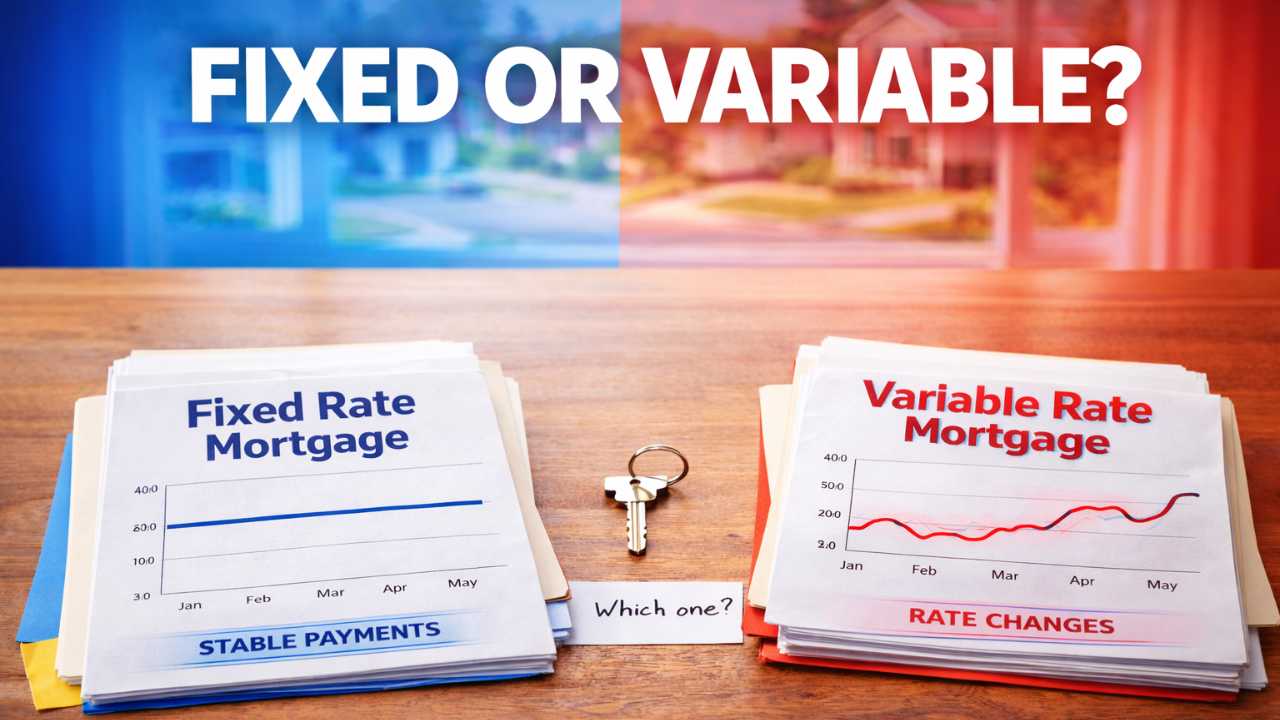
When you’re getting a mortgage in Alberta, one of the first decisions you’ll face is whether to choose a fixed rate or a variable rate.
I get this question from clients all the time. Many people assume one option is always better than the other, but that’s not really how mortgages work. The right choice depends on your comfort level, your financial situation, and what’s happening in the economy.
If you’re buying a home in Alberta, here’s how I explain the difference.
What does a fixed mortgage rate mean?

A fixed-rate mortgage means your interest rate stays the same for the entire mortgage term, which is often five years in Canada. Your payment stays consistent during that time, which makes budgeting straightforward. Many homeowners prefer fixed rates because they provide stability. Your payments don’t change if interest rates rise, which can provide peace of mind during uncertain economic periods.
The trade-off is that fixed rates are often slightly higher than variable rates. You’re essentially paying a little extra for predictability.
Another thing many people don’t realize is that breaking a fixed mortgage early can come with larger penalties. These penalties are often based on something called the interest rate differential, which can make them more expensive than variable-rate penalties.
In short, fixed rates tend to work well for people who value stability and want to know exactly what their payment will be each month.
What does a variable mortgage rate mean?
A variable-rate mortgage works differently. Instead of locking in one rate, your interest rate moves up or down based on your lender’s prime rate, which is influenced by the Bank of Canada’s policy rate. When the prime rate changes, your mortgage rate changes as well.
Depending on the type of variable mortgage, your monthly payment may change, or the portion of your payment that goes toward interest versus principal may shift.
Historically, variable rates have often been lower than fixed rates, which means borrowers can sometimes save money over the life of their mortgage. The downside is that variable rates come with uncertainty. If interest rates rise, your borrowing cost can increase. For some homeowners, that unpredictability is uncomfortable. For others, it’s a reasonable trade-off for the potential savings.

Why do most Albertans still choose fixed?
Even though variable rates have historically saved borrowers money over long periods, most Canadians still choose fixed rates.
Recent mortgage consumer surveys show that a majority of borrowers choose fixed-rate mortgages, particularly the five-year fixed term, because it provides predictability in their monthly payments. When people are buying a home, especially for the first time, the stability of knowing exactly what their payment will be can feel reassuring.
How do I help clients decide between fixed and variable?
In my experience as a mortgage broker, the fixed versus variable decision rarely comes down to trying to “beat the market.” Instead, I usually ask clients a few simple questions.
- First, how comfortable are you with change? If the idea of your mortgage payment increasing makes you anxious, a fixed rate may help you sleep better at night.
- Second, how stable is your financial situation? If your income is predictable and you have a financial cushion, you may be more comfortable with the ups and downs of a variable rate.
- Third, how long do you expect to keep the mortgage? If you may sell or refinance before the term ends, the lower penalties on variable mortgages can sometimes provide more flexibility.
There is no universal answer. The right mortgage is the one that fits your life.
Is the interest rate the only thing that matters?
Choosing a mortgage is not just about the interest rate. Your prepayment options, penalty structure, flexibility, and long-term plans all matter just as much as the rate itself. Two mortgages with the same rate can behave very differently if you need to refinance, move, or pay the mortgage down faster. That’s why I spend time walking clients through the details instead of just quoting a rate.
What’s my advice as an Alberta mortgage broker?
If you’re buying a home in Alberta right now, the fixed versus variable conversation is important. Interest rates move in cycles, and no one can predict them perfectly. What you can do is choose a mortgage that fits your comfort level and your long-term plans. For some people, that means locking in stability with a fixed rate. For others, it means accepting some fluctuation in exchange for flexibility and potential savings.
If you’re unsure which option is right for you, that’s exactly where a mortgage broker can help. I work with multiple lenders and help my clients understand the real differences between their options so they can make a confident decision about one of the biggest financial commitments they’ll ever make. Contact me today to get started!
How an Alberta mortgage broker helps you choose fixed or variable
This decision is worth more than the quarter-point everyone argues about. Here’s what we actually work through:
- We compare fixed and variable side by side on today’s real rates from multiple lenders, not a posted rate.
- We read the penalty clause before you sign, because an IRD penalty on a fixed mortgage can cost far more than a variable one.
- We check the prepayment privileges and flexibility — two mortgages at the same rate can behave completely differently.
- We ask how long you expect to keep it, since selling or refinancing mid-term changes which option wins.
- We stress-test the payment so a variable rate rising is a scenario you’ve already seen, not a surprise.
- We work with buyers and homeowners across Calgary, Edmonton and all of Alberta.
Not sure whether fixed or variable fits you?
Let’s put both options in front of you with your real numbers, including the penalty you’d face if your plans change.
Apply Online → Book a Discovery Call → Serving Calgary, Edmonton & all of Alberta · Mortgages for Less with INDI MortgageFixed vs variable mortgages in Alberta: common questions
What is the difference between a fixed and a variable mortgage rate?
Is a fixed rate higher than a variable rate?
Which mortgage has the bigger penalty if I break it early?
Does my payment change on a variable-rate mortgage?
Do most Canadians choose fixed or variable?
How do I decide between fixed and variable?
Is the interest rate the only thing that matters when choosing a mortgage?
This article is general information for Alberta homebuyers and homeowners, not financial, mortgage, tax or legal advice. Interest rates, lender penalty calculations and prepayment terms vary by lender and change over time, and past rate patterns do not predict future ones. Any mortgage is subject to lender approval. Please speak with a licensed mortgage professional about your specific situation. Mortgages for Less with INDI Mortgage.