
By Josh Tagg, mortgage broker · Mortgages for Less with INDI Mortgage · Calgary, serving all of Alberta ·
How much do you need for a down payment? You might have heard it’s 5%, or maybe you’ve heard it’s better to have 20%. Both are options in Canada, but they work quite differently.
In this article, I’ll walk you through how each option works, the pros and cons, and how to decide which one may fit your situation best.
What Is 5% Down?

A 5% down payment is the minimum required for many homes in Canada, especially for first-time buyers.
Here’s how it works. You put down at least 5% of the purchase price, and the remaining amount is covered by your mortgage. Because you are borrowing more than 80% of the home’s value, you are required to have mortgage default insurance (often through CMHC or other insurers).
Key points:
- Minimum entry point into the housing market
- Requires mortgage insurance
- Allows you to buy sooner with less savings
Many first-time buyers choose 5% down because it gets them into the market faster. Instead of waiting years to save a large down payment, they can start building equity sooner.
What Is 20% Down?
A 20% down payment means you are putting down one-fifth of the home’s value upfront.
With 20% or more down, your mortgage is considered “conventional,” which means you do not need mortgage default insurance.
Key points:
- No mortgage insurance required
- Lower loan-to-value ratio
- Often results in lower monthly payments
Why some buyers choose it:
Buyers who have more savings or who are selling a previous home often choose 20% down to reduce their borrowing costs and monthly payments.
What are the pros and cons of each?
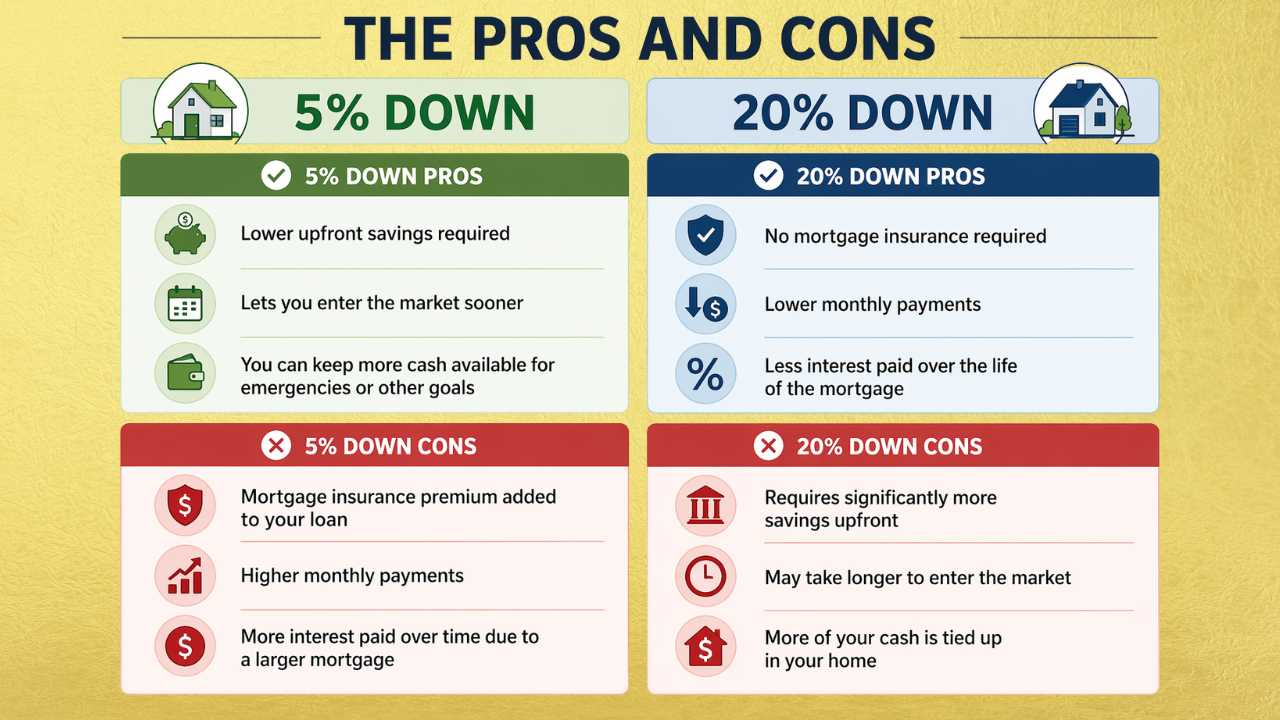
5% Down Pros – This option means you require lower savings upfront, you can enter the market sooner, and you can keep the rest of your savings available for emergencies or other goals.
5% Down Cons – On the flip side, when you put down less than 20% you are required to have a mortgage insurance premium added to your loan, the monthly payments will be higher, and you will likely pay more interest over the life of your mortgage simply because it is bigger.
20% Down Pros – When you put 20% down you aren’t required to have mortgage insurance, you will have lower monthly payments, and you will likely pay less interest over the life of the mortgage.
20% Down Cons – However, this requires significantly more savings up front, which means you may take longer to enter the market, and you’ll have less left over for emergencies or other projects.
Which Option Is Better for First-Time Buyers?
This really depends on your situation and what you want to achieve.
If affordability and timing are your biggest concerns, 5% down can make a lot of sense. I work with many clients who want to stop renting and start building equity as soon as possible. In those cases, getting into the market earlier is often the priority.
If you have stable income but limited savings, 5% down can still be a strong option. It allows you to move forward without waiting years to build a larger down payment.
On the other hand, if you have the savings available and want lower monthly payments, 20% down may be the better fit. This is especially true for buyers who prefer more financial stability and less monthly pressure.
For some buyers, flexibility is key. Keeping extra savings on hand instead of putting everything into the down payment can provide peace of mind, especially in the first year of homeownership when unexpected costs can come up.
What mistake do many first-time buyers make?
One mistake I see is buyers assuming that 20% down is always the “better” or “smarter” choice.
In reality, it depends on timing. If home prices are rising, waiting to save 20% could mean the home you want becomes more expensive while you wait.
I’ve seen buyers delay their purchase for years trying to reach 20%, only to find that prices moved faster than their savings. In some cases, they would have been better off buying earlier with 5% down.
How does a mortgage broker help you decide?

When I sit down with clients, I look at your full picture: your income, your savings, your monthly comfort level, and your long-term goals.
We can compare what your payments would look like with 5% down versus 20% down. We can also talk about how much cash you should realistically keep aside after your purchase. The goal is to help you make a decision that feels comfortable and sustainable, not just one that looks good on paper.
If you’re trying to decide between 5% down and 20% down, the best next step is understanding what your mortgage options actually look like. Book a call with me to get started!
How an Alberta mortgage broker helps with the down payment decision
This decision is usually made with a rule of thumb when it should be made with numbers. Here is what a broker actually does with it:
- We run both scenarios side by side — the payment, the insurance premium and the total interest at 5% down versus 20% down on the price you are actually shopping.
- We work out what you qualify for under each, since a smaller down payment means a larger mortgage to carry.
- We check how much cash you should keep back after closing, so the first year of ownership isn’t funded by a credit card.
- We compare multiple lenders, because insured and conventional mortgages are priced differently and not every lender is best at both.
- We put a real number on the cost of waiting, so saving toward 20% is a choice you made on purpose rather than a default.
- We confirm where your down payment is coming from and what the lender will want to see to prove it.
Want to see 5% down and 20% down side by side?
Get your real numbers on both options — the payment, the premium and what you qualify for — before you decide how long to keep saving.
Apply Online → Book a Discovery Call → Serving Calgary, Edmonton & all of Alberta · Mortgages for Less with INDI Mortgage5% down vs 20% down: common questions
What is the minimum down payment in Canada?
Why does 5% down require mortgage insurance?
What does a 20% down payment get you?
What are the downsides of putting only 5% down?
What are the downsides of putting 20% down?
Is 20% down always the smarter choice?
Which option is better for a first-time buyer?
This article is general information for Alberta homebuyers, not financial, mortgage, tax or legal advice. Down payment minimums, default insurance rules, premiums and mortgage rates change, and any mortgage is subject to lender approval. Please speak with a licensed mortgage professional about your specific circumstances. Mortgages for Less with INDI Mortgage.