
By Josh Tagg, mortgage broker · Mortgages for Less with INDI Mortgage · Calgary, serving all of Alberta ·
You might have noticed that mortgage rates have started climbing again. If you’re wondering why, a lot of my clients have been asking me the same question. The short answer is this. Bond yields have jumped quickly, and fixed mortgage rates are following right behind them.
But what’s actually driving that move is bigger than just Canada. It’s global, and it starts with something most people expect: oil and geopolitical tension.
What’s happening right now with fixed mortgage rates?
We’ve seen a fresh round of fixed mortgage rate increases, with some lenders raising rates by as much as 0.30%. This isn’t random.
The five-year Government of Canada bond yield, which is what fixed mortgage rates are based on, has surged more than 0.60% (60 basis points) in a very short time. It recently pushed above 3.20% after being much lower just weeks ago.
When bond yields move this quickly, lenders don’t wait. They adjust pricing fast, and that’s exactly what we’re seeing now. In simple terms, the cost for lenders to fund fixed mortgages has gone up, so mortgage rates go up too.
Why are bond yields rising?
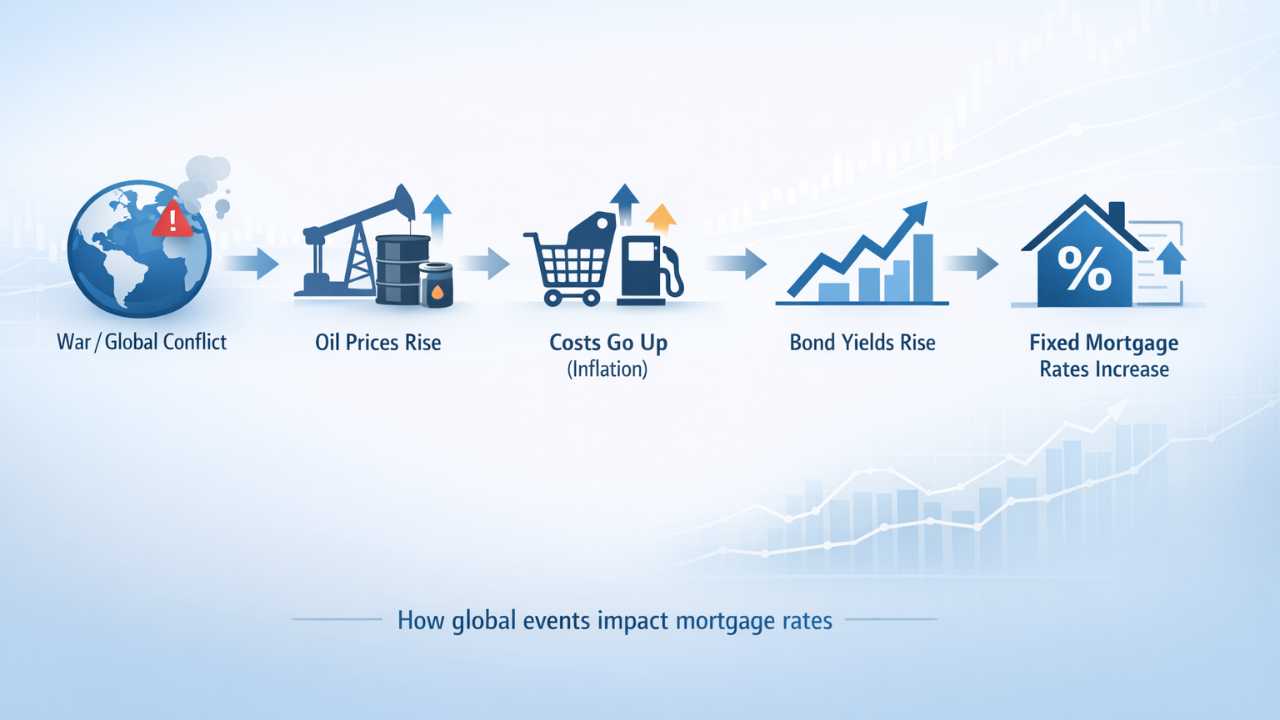
The main driver right now isn’t something happening inside Canada. It’s global, and it ties back to the conflict involving Iran and rising oil prices.
- War pushes oil prices up.
- Higher oil prices push inflation up.
- Higher inflation pushes bond yields up.
- And higher bond yields push fixed mortgage rates up.
Oil affects almost everything in the economy. Transportation, food, goods, services. When oil spikes, costs rise across the board. That creates inflation pressure, and inflation is the number one enemy of bonds.
If you’re an investor and inflation is rising, you don’t want to lend money at low rates. You demand a higher return. That’s why bond yields climb.
Why are rates moving so fast?
One thing that surprises people is how quickly this can all change.
We’ve already seen days where bond yields surged to multi-month highs, only to drop sharply within hours on headlines about possible de-escalation in the Middle East. At one point, yields fell by around 20 basis points in a single move just on news that tensions might ease. That tells you everything you need to know about this market right now.
Rates are being driven by expectations, not just data. And expectations can change fast. As long as oil prices remain elevated or unpredictable, bond yields are going to stay volatile. That means fixed mortgage rates will do the same.
What does the Bank of Canada have to do with this?

Even though fixed rates are driven by bond yields, the Bank of Canada still plays a role through expectations.
Right now, markets are starting to price in the possibility of future rate hikes again, mainly because of inflation risks tied to higher oil prices. Interestingly, the Bank of Canada itself has been more cautious. They’ve said they may “look through” a temporary oil-driven inflation spike, especially since the broader economy is still showing signs of weakness.
But markets don’t always wait for the Bank to act. They move ahead of it. And right now, the market is leaning toward higher rates, not lower ones.
What does this mean if you’re buying or renewing?
If you’re a homebuyer or homeowner in Alberta, here’s what I want you to know.
If you already secured a rate hold, you’re in a good position for now. Those holds can protect you from short-term increases. If you haven’t, you’re now dealing with a higher rate environment than even a few weeks ago.
We’re also starting to see more people reconsider variable rates again, simply because the gap between fixed and variable is widening. There’s no one-size-fits-all answer here. It depends on your comfort level, your timeline, and your financial situation.
What’s my take as a mortgage broker?
What I’m telling my clients right now is simple.
This isn’t just a “Canada story.” It’s a global story driven by oil, inflation, and uncertainty. That also means things can change quickly in either direction. If tensions ease and oil drops, we could see bond yields fall and fixed rates improve. If things escalate, we could see further increases. The key right now is having a strategy, not guessing.
If you’re trying to decide between fixed or variable, or you’re wondering whether to lock something in, reach out. I’ll walk you through your options in plain language so you can make a confident decision based on your situation, not the headlines.
How an Alberta mortgage broker helps when fixed rates are climbing
When bond yields are swinging on the day’s headlines, a strategy beats a guess:
- We lock in a rate hold early so a short-term jump doesn’t cost you.
- We compare fixed and variable side by side as the gap between them widens.
- We explain why fixed rates follow bond yields and variable rates follow the Bank of Canada — and what that means for your timing.
- We shop multiple lenders, since not every lender reprices by the same amount or on the same day.
- We work with buyers and homeowners across Calgary, Edmonton and all of Alberta.
Buying or renewing while rates are moving?
Get a rate hold in place and a plain-language plan for fixed versus variable, built around your situation — not the headlines.
Apply Online → Book a Discovery Call → Serving Calgary, Edmonton & all of Alberta · Mortgages for Less with INDI MortgageRising fixed mortgage rates: common questions
Why are fixed mortgage rates going up in Canada?
What is pushing bond yields higher?
Why do oil prices affect mortgage rates?
Does the Bank of Canada set fixed mortgage rates?
Could fixed mortgage rates come back down?
Does a rate hold protect me from rising rates?
Should I choose a fixed or variable mortgage right now?
This article is general information for Alberta homebuyers and homeowners, not financial, mortgage, tax or legal advice. It reflects bond-market and mortgage-rate conditions as of March 2026; rates, bond yields and policy change, and future rate movements cannot be predicted with certainty. Any mortgage is subject to lender approval. Please speak with a licensed mortgage professional about your specific situation. Mortgages for Less with INDI Mortgage.