When Ryan and Sarah* first called, they weren’t shopping for a better rate. They were trying to figure out how to keep their home.
By Josh Tagg, mortgage broker · Mortgages for Less with INDI Mortgage · Calgary, serving all of Alberta
They owned a house in an established community in southeast Calgary — a home they’d worked hard for and that had grown to be worth about $1,000,000. But everything had come at once. Sarah had broken her leg and was off work after surgery, which dropped the household to one income. Two mortgage payments had slipped late. And quietly, in the background, the couple had started to separate.
Their mortgage was with an alternative (“B”) lender — the kind of lender you end up with when your credit was bruised at the time you bought — and the term was maturing in a matter of weeks. When they went to renew, the answer came back: after the recent late payments, the lender would not renew them. Not long after, the file crossed a line most people never see coming this fast — the mortgage matured and the lender’s lawyers issued a foreclosure demand, with a hard deadline to pay the balance in full.
The turning point: foreclosure wasn’t the only door
Ryan believed the situation was close to hopeless — that if the lender wouldn’t renew and the foreclosure clock was running, losing the house was just a matter of time. What he didn’t know is that a homeowner with real equity almost always has options, even when banks say no.
The tool for a moment like this is a private mortgage — short-term financing from a lender that looks first at the equity in the home and the borrower’s ability to make a payment, rather than at a perfect credit and income history. It is more expensive than a bank. But it is designed for exactly this: a temporary problem that needs a bridge, not a forever mortgage.
“The mortgage was never really the problem. The equity in the home was the solution — they just needed time to use it.”
What we actually did
Confirmed the equity
A rush appraisal came in at $1,000,000. Against a payout under $500,000, that left a large equity cushion — the foundation any private lender needs.
Shopped it hard — and lined up a backup
The first lender declined. We kept going, secured an approval from a private lender, and signed a second lender’s approval as insurance so the deadline couldn’t sink the deal.
Structured it to protect cash flow
The new mortgage was interest-only, with a full year of payments prepaid from the advance — so the mortgage largely carried itself during the year they needed to sell.
Not every rescue is a “debt consolidation”
It’s worth being clear about what this file wasn’t. Ryan and Sarah didn’t have piles of credit-card debt to roll in — their consumer debts were small. The entire problem was the mortgage itself: it had matured, it couldn’t be renewed, and it was in foreclosure. So the new mortgage wasn’t about consolidating — it was about replacing a mortgage no one would renew, buying time, and keeping the payment survivable through a hard year. Here’s where the new $579,000 mortgage actually went:
| What it covered | Amount |
|---|---|
| Paid out the existing (matured) mortgage | $483,505 |
| One year of interest, prepaid from the advance | $54,947 |
| Lender & broker fees (built into the mortgage) | $31,325 |
| Legal, independent legal advice & title insurance | $3,895 |
| Interest adjustment & closing buffer | $5,328 |
| New private mortgage | $579,000 |
A single new mortgage at about 57% of the home’s value — well within the equity available — that cleared the foreclosure and funded the year ahead.
The before & after that made it survivable
The rate on private money isn’t a bank rate — this mortgage was priced at 9.49%, reflecting the risk and the speed. But the structure is what made it liveable. Instead of asking a one-income household mid-separation to find a mortgage payment every month, the lender prepaid the whole year’s interest out of the advance. During the year Ryan and Sarah needed to sort things out and sell, their out-of-pocket mortgage payment was effectively zero.
| Monthly mortgage cost during the sale year | Before | After |
|---|---|---|
| Mortgage payment they had to find each month | $4,903 | $0* |
| Monthly breathing room | — | ~$4,900 |
*The year’s interest wasn’t free — it was prepaid from the home’s equity when the mortgage funded. But it removed the monthly payment at the exact moment the household couldn’t carry one.
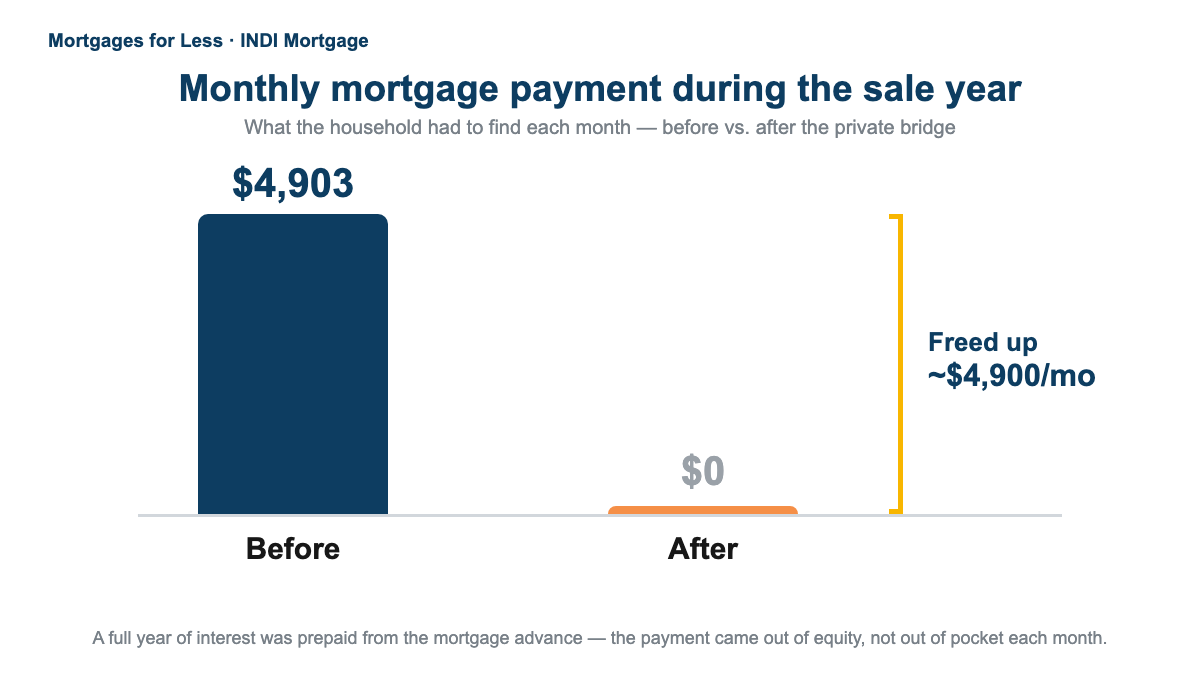
The point of a bridge like this isn’t that it’s cheap — it isn’t. It’s that it turns an emergency into a plan. The new mortgage of $579,000 on a $1,000,000 home left the couple at about a 57% loan-to-value, with more than $400,000 of equity still protected — equity that a rushed foreclosure sale could have torched.
What foreclosure would have cost them
Left alone, the path was ugly. A lender-driven foreclosure sale rarely gets full market value, comes loaded with legal and court costs, and leaves a lasting mark on your credit that can shadow both people for years. For a couple already separating, it would have meant losing the home and a chunk of the equity they were counting on to move forward separately.
Could this help you?
Being declined at renewal, or watching a mortgage slide toward foreclosure, feels like the end of the road. Often it isn’t — especially if you own your home and have built up equity. A short-term private mortgage may be worth exploring if:
- Your lender won’t renew you, or you’ve been declined for a switch or refinance
- You’ve fallen behind, received a demand or foreclosure notice, or your term is maturing fast
- You own a home in Alberta with meaningful equity built up
- Your income or credit has taken a temporary hit — illness, job change, separation
- You need time — to recover, to sell on your own terms, or to get back to a bank
Private financing isn’t the right answer for everyone, and it should always come with a clear exit plan — a way back to a normal mortgage, or a planned sale. The only way to know what’s realistic for your situation is to have someone look at your home’s value, your equity and your timeline. That conversation is free, and there’s no obligation.
Declined at renewal, or worried about foreclosure?
If a bank has said no, or your term is running out, don’t wait until options disappear. Tell us your situation and we’ll show you what’s actually possible — fast, and in plain English.
Get Your Options → Serving Calgary, Edmonton & all of Alberta · Mortgages for Less with INDI MortgagePrivate & bridge mortgages: common questions
What is a private mortgage, and when does it make sense?
My lender won’t renew my mortgage — what are my options?
Can I still get financing if my mortgage is already in foreclosure?
Is a private mortgage expensive?
What do “interest-only” and “prepaid interest” mean?
Can I get a mortgage in the middle of a separation?
How fast can a private mortgage fund?
I’m in Edmonton or a smaller Alberta town — can you still help?
*Names and identifying details have been changed to protect client privacy. This case study is based on a real client file; the dollar figures shown reflect that file and are provided for illustration only. Every mortgage situation is different — rates, penalties, equity, qualification and results vary by individual and by lender, and are subject to change and to lender approval. Private and bridge mortgages carry higher rates and fees than conventional mortgages and are intended as short-term solutions with a defined exit plan. This article is general information, not financial, mortgage or legal advice. Please speak with a licensed mortgage professional about your specific circumstances. Mortgages for Less with INDI Mortgage.