Quick answer: No. On August 28, 2026, Statistics Canada reported the economy grew 3.3% annualized in the second quarter — the fastest pace since early 2023 — and quietly revised the first quarter from slightly negative to positive. That revision erased the “two negative quarters” the recession label depended on, and the IMF now ranks Canada the second-fastest-growing economy in the G7. The economy is not shrinking — but households are genuinely stretched: real wages still trail the post-2020 inflation, and consumer insolvencies just hit their highest level since 2009. Growth on paper, strain at the till. Both are true, and anyone showing you only one of them is selling you something.
What did the August 28 GDP report actually say?
Two things, and the second one matters more than the headline. First, real GDP rose 0.8% in the second quarter — about 3.3% at an annual rate — comfortably ahead of the Bank of Canada’s own 2.5% call, and even on a per-person basis output rose 1.0%. Second, and much quieter: Statistics Canada revised the first quarter upward, from a small decline to slightly positive growth.
That revision is the part almost nobody will read, and it’s the part that quietly settles a months-long argument.
So was Canada ever really in a recession?
The “technical recession” definition is simple: two back-to-back quarters where the economy shrinks. The story started with two soft prints — an initial reading showing the economy contracting late in 2025, and again, barely, in the first quarter of 2026. That was enough for a talking point to take off.
The Conservatives ran hard with it. In a letter to the Prime Minister on May 31, Pierre Poilievre wrote that Canada had become “the only leader in the G7 to have taken your country into a recession” and called for an emergency debate. It was a clean, quotable line. It was also built on a preliminary number.
Preliminary is the key word. GDP is an estimate that gets refined as more data comes in, and this one got refined in the other direction: the first quarter is now positive, which breaks the two-in-a-row definition, and the second quarter came in hot. Meanwhile the IMF projects Canada to be the second-fastest-growing economy in the G7 this year, behind only the United States. “The only country in recession” and “the worst economy in the G7” were the two halves of the claim. The data contradicts both.
And it isn’t just the forecasters — follow the money. In an August analysis for Bloomberg, Matt Winkler, the founding editor-in-chief of Bloomberg News, laid out where global capital is actually heading, and the answer was Canada: foreign investors poured roughly $183 billion into Canadian stocks and bonds over the past year. Money that size does not chase the worst economy in the club. When the forecasts and the capital flows both point the opposite way from the slogan, it’s worth asking who benefits from the slogan.
Let me be blunt about my own bias: I’m not here to carry water for anyone in Ottawa. A soft patch is a soft patch, and plenty of people are genuinely hurting. But the specific claim — recession, worst in the club — is false, and it stayed in heavy rotation long after the numbers put a stake through it.
The spin didn’t stop when the data changed
By mid-August the doom content was everywhere. Here’s a fair sample from the Conservative leader’s own feed — slick, professionally produced, engineered to travel:
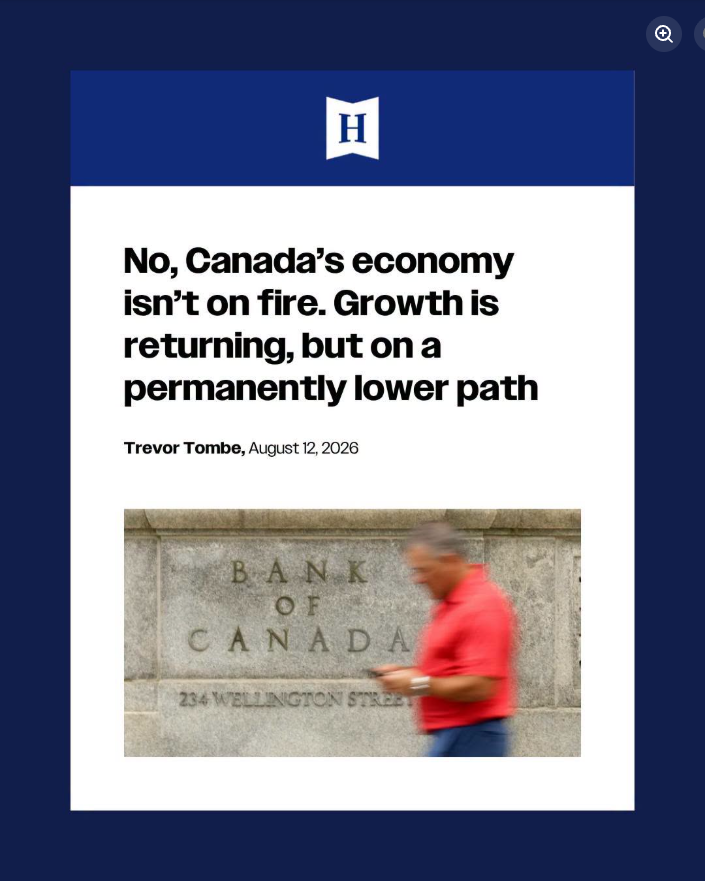
Study how good this is. It concedes the part it can’t deny — “growth is returning” — then reframes the win as a life sentence on a “permanently lower path,” and drapes a real economist, Trevor Tombe, over the top for authority. The sleight of hand: Tombe’s actual argument is about long-run productivity and output per person — a real, worth-having debate — not a claim that Canada is in a recession. Take a legitimate concern, strip the nuance, wrap it in campaign colours, and you’ve manufactured despair out of a growth report. That’s not analysis. It’s a mood, built to order.
But don’t let me spin you either — some of the doom is real
Here’s where I get off the cheerleaders’ bus too. A rising GDP is not a licence to tell people their pain is imaginary. Look at this one:
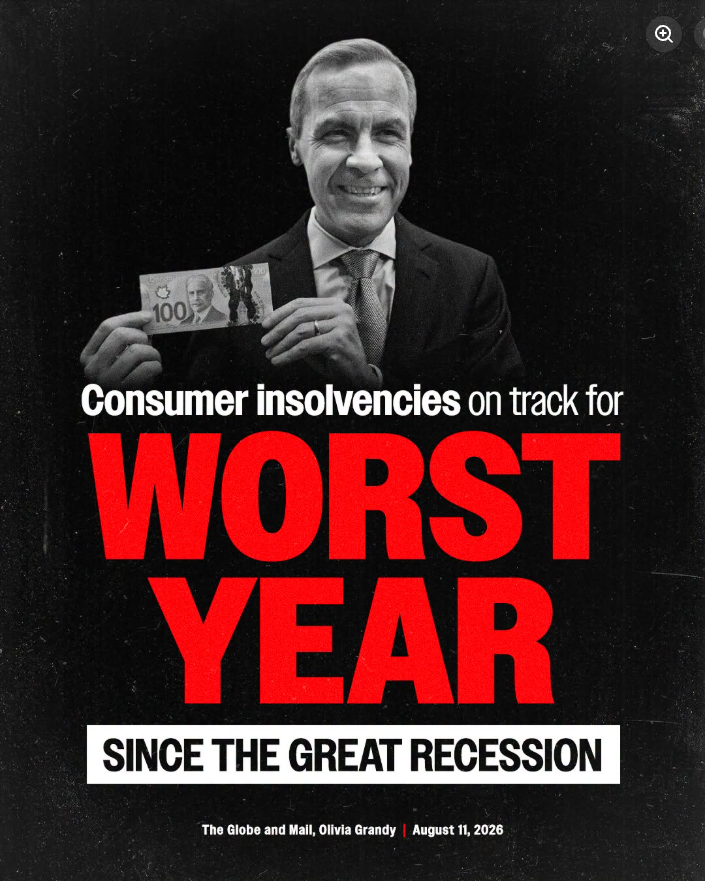
This one is true. I checked. Canadians filed 37,523 consumer insolvencies in the second quarter of 2026 — the most in any quarter since 2009, the pit of the financial crisis, and in the first quarter that worked out to roughly seventeen filings every hour. The Globe headline the graphic quotes is real, and it’s accurate.
So here’s the whole board — which neither side will show you at once: the country is growing and its households are going broke at the same time. That’s not a contradiction. GDP counts the economy; insolvencies count the people. The first is up and the second is the worst in seventeen years — and if you only ever see one of those two numbers, it’s because someone picked which one you’d be angry about.
So why does it still feel like a recession?
Because for most households it basically does — just not for the reason the headline screams. Prices are up about 24% since the start of 2020 — Canada’s consumer price index climbed from 136.8 in January 2020 to 169.9 in July 2026. Wages rose too, but slower: the median real hourly wage fell nearly 5% between 2020 and 2022 and still hasn’t fully clawed back (StatCan’s own explainer on real versus nominal pay). You can get a raise every year and still fall behind — and when the credit-card minimums finally win, you become one more entry in that insolvency count.
That’s the real diagnosis: not a shrinking economy, but a cost-of-living hangover from the worst inflation in forty years that wages haven’t burned off yet. Call it a “recession” and you’ve got the disease wrong — which is awfully convenient for whoever’s selling you the cure.
Why the mood keeps running darker than the math
Ask who profits from you being scared. “We grew 3.3% and the recession got revised away” raises no money and wins no clicks. “We’re the only country in the G7 in recession” is a fundraising email, a viral post, and a reason to rage-tune-in tomorrow. Rage is the most profitable emotion on the internet, and the feed you read the economy through is a machine built to keep you angry, because angry keeps you scrolling. On that scoreboard the scary lie laps the boring truth before the truth has its shoes on.
So the alarm blares on day one and the correction — buried in a statistical revision nobody shares — never catches it. And don’t flatter yourself that only one team runs this play. The Conservatives wave the insolvency number and bury the growth; the government waves the growth and buries the insolvencies. Both numbers are real. Both sides are lying to you by omission and betting you’re too worn out to check. On social media you are not the audience — you’re the product being sold.
Alberta separatism is the tell
I am from Alberta, so let me point at the smoke detector in my own kitchen. Support for separation tracks the mood, not the fundamentals. When the recession talk was loudest early this year, separatist sentiment ran up around 28–30%. A few months later, as the panic drained out, Ipsos had it back down to 18%, with about seven in ten Albertans wanting to stay.
Nothing about Alberta’s economy transformed in five months. The narrative did. Somebody needed you furious in January, and the sentiment followed the story like a dog on a leash. The frustrations underneath are real — I hear them at my desk every week — which is exactly what makes them such useful raw material for anyone with a plan for your anger. The grievance is honest. Most of the people amplifying it are not.
What this actually means for your mortgage
This is where it gets practical, because the recession question isn’t academic — people are making renewal and rate decisions based on it.
If you believe the economy is collapsing, you assume the Bank of Canada is about to slash rates to rescue it, and you make your mortgage bet accordingly. But a growing economy with inflation still near 3% is not a bank in a hurry to cut. The Bank held its policy rate at 2.25% on July 15, and a 3.3% growth print gives it every reason to stay patient. Betting your renewal on emergency cuts that a healthy economy won’t deliver is exactly the trap the doom narrative sets.
And remember the mechanics: your fixed rate is priced off government bond yields, not the Bank’s overnight rate. The 5-year Government of Canada yield is sitting around 3.30%, which is why 5-year fixed offers are near 4.9% (insured rates between 4.09% and 4.54%) and variable is closer to 3.5–4.0%. Stronger-than-expected growth tends to push yields up, not down — the opposite of what “we’re in a recession” would imply. Here’s the honest read as of late August 2026:
| Indicator | Level | What it tells you |
|---|---|---|
| BoC policy rate | 2.25% | Held July 15; growth gives the Bank room to wait |
| 5-yr Gov’t of Canada yield | ~3.30% | The engine under fixed rates |
| 5-yr fixed (uninsured) | ~4.89% | Won’t tumble on cuts that aren’t coming |
| 5-yr variable | ~3.7%–3.95% | Moves only when the Bank actually moves |
None of that tells you fixed or variable — that depends on your renewal date, your amortization, and how much payment uncertainty you can stomach. But it does mean the decision should be built on what the economy is actually doing, not on a headline that the data already retired.
And because it’s literally my job to say it: if you make a six-figure decision about your mortgage based on a Facebook graphic — anyone’s graphic, mine included — you’re doing exactly what the graphic was built to make you do. Read the instruments. Then talk to someone whose job is to read them with you.
Want your own numbers read straight, without the outrage filter?
Book a no-pressure call and we’ll look at your renewal, your rate options, and what the current data actually means for you.
Run your mortgage numbers →The honest limits
Revisions cut both ways — this strong Q2 could itself be revised lower later, and I’ll own that if it happens. Growth on aggregate doesn’t mean every household or every sector is fine; a lot of people are genuinely stretched. And the biggest real risk on the board isn’t a phantom recession, it’s the live trade fight with the United States, which could still knock the economy off course. My point isn’t “everything’s great.” It’s narrower and, I think, more useful: we are not in the collapse the feeds keep implying, and reading the economy through those feeds will cost you money.
Frequently asked questions
Is Canada in a recession right now?
No. Statistics Canada reported 3.3% annualized growth in the second quarter of 2026 and revised the first quarter up to positive, so the economy is not contracting.
Didn’t Canada have a recession in 2025–2026?
Early estimates showed two soft quarters, which fuelled a “technical recession” claim. The August 28, 2026 release revised the first quarter to positive growth, which breaks the two-consecutive-negative-quarters definition.
Is Canada the worst-performing economy in the G7?
No. The IMF projects Canada to be the second-fastest-growing G7 economy in 2026, behind only the United States, and foreign investors poured roughly $183 billion into Canadian stocks and bonds over the past year.
If we’re not in a recession, why does everything feel so expensive?
Because prices are up about 24% since 2020 and real wages fell about 5% between 2020 and 2022 and haven’t fully recovered. It’s a cost-of-living and lost-purchasing-power problem, not a shrinking economy.
Are more Canadians actually going broke?
Yes. Consumer insolvencies hit 37,523 in the second quarter of 2026, the highest quarterly level since 2009. That part of the “bad economy” story is true even though the recession claim isn’t: the economy is growing while many households are not.
Will the Bank of Canada cut interest rates soon?
A growing economy with inflation near 3% reduces the pressure to cut. The Bank held its policy rate at 2.25% in July 2026 and has room to stay patient.
Should I choose a fixed or variable mortgage right now?
It depends on your renewal date, amortization, and tolerance for payment changes. Just don’t base it on the assumption that big rate cuts are imminent — the current data doesn’t support that.
This article is general commentary and market opinion, not financial, investment, or political advice. Economic figures and mortgage rates are as of August 2026 and change; confirm current numbers before making any decision. Josh Tagg is a licensed mortgage broker with Mortgages for Less.