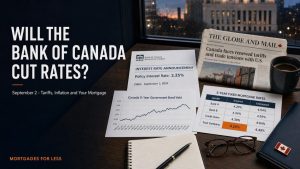
Just when Canadians were starting to enjoy the idea that interest rates might finally become boring again, gasoline prices wandered back into the room and knocked over the furniture. The Bank of Canada held its policy rate at 2.25% on September 2, but its latest discussions show that policymakers are becoming more concerned about persistently high gasoline and diesel prices.
If those higher energy costs start spreading into the price of other goods and services, the Bank has warned that it may eventually need to respond with higher interest rates. In other words, rate hikes are back in the conversation. That doesn’t mean the Bank is reaching for the big red “raise rates” button just yet, but Alberta homeowners, buyers and anyone with a mortgage renewal coming up probably shouldn’t assume the next move will automatically be down.
Why is the Bank of Canada worried about more than your gas receipt?

Headline inflation has been running near 3%, which is close to the top of the Bank of Canada’s 1% to 3% target range, and gasoline has been a big part of that. The more reassuring part is that inflation excluding gasoline has been closer to 2.2%, while the Bank’s measures of underlying inflation have remained around 2%.
So far, expensive fuel hasn’t completely escaped the gas station and started running around the economy unsupervised. That’s what the Bank is watching for, because fuel affects far more than your commute. Trucks move groceries, contractors drive to job sites, airlines need fuel and businesses ship products across the country.
If those costs stay high long enough, companies can start passing them along to consumers. Suddenly, your expensive tank of gas has invited groceries, airline tickets and building materials to the inflation party.
Why do high oil prices cut both ways for Alberta?
Alberta has a slightly more complicated relationship with high oil prices than much of the country. At the household level, expensive gasoline is clearly not fun. Families pay more to commute, travel and move goods around, and if energy costs eventually push inflation higher, we could also see upward pressure on interest rates.
That’s the bad news. The good news is that Alberta is an energy-producing province, so higher oil prices can support energy investment, employment, government revenues and activity across other parts of the provincial economy.
That means Alberta can benefit from higher oil prices while simultaneously complaining about the price at the pump. We are nothing if not versatile.
Is the Bank of Canada about to raise rates?

Probably not immediately. Canada’s economy is still showing signs of weakness, and the Bank has pointed to excess supply in the economy, a softer labour market and ongoing uncertainty surrounding U.S. tariffs and global trade. Those factors could slow economic growth and reduce inflationary pressure.
That leaves the Bank in an awkward position. Raise rates too soon, and it risks putting additional pressure on an already soft economy. Wait too long, and higher energy costs could start feeding into broader inflation.
Capital Economics argued on September 17 that the Bank is likely to “drag its feet a bit longer on hikes.” In other words, the risk of higher rates has increased, but that doesn’t mean a hike is imminent. The next Bank of Canada rate announcement is scheduled for October 28, along with a new Monetary Policy Report.
What does this mean for Alberta mortgage borrowers?
The biggest takeaway isn’t that rates are definitely going up. It’s that the direction of rates has become less predictable. Variable mortgage rates respond directly to changes in the Bank of Canada’s policy rate, while fixed mortgage rates work differently because they’re influenced much more by Government of Canada bond yields, which can move well before the Bank changes anything.
If you’re buying, renewing or refinancing in the next few months, I wouldn’t build your mortgage plan around the hope that rates will definitely be lower later. Hope is wonderful. It is slightly less useful in a mortgage qualification.
Instead, look at the options available today, compare fixed and variable choices carefully, and make sure the payment works comfortably even if rates don’t cooperate. For the last few years, Canadians kept asking, “When is the Bank going to cut again?” We may now be entering a period where the better question is, “How long can the Bank sit still before inflation makes it move?”
For answers to your questions, contact me.
How an Alberta mortgage broker helps when rates are unpredictable
When the next rate move could go either way, a plan beats a guess:
- We compare fixed and variable options side by side on today’s actual rates.
- We explain how variable rates follow the Bank of Canada while fixed rates follow bond yields — and what that means for your timing.
- We check that your payment still works comfortably if rates don’t cooperate.
- We plan renewals and refinances ahead of time instead of waiting on a hoped-for cut.
- We work with buyers and homeowners across Calgary, Edmonton and all of Alberta.
Buying, renewing or refinancing in the next few months?
Don’t build your plan on a rate cut that may not come. Let’s look at the options available to you today.
Apply Online → Book a Discovery Call → Serving Calgary, Edmonton & all of Alberta · Mortgages for Less with INDI MortgageGas prices and Bank of Canada rate hikes: common questions
Is the Bank of Canada going to raise interest rates?
Why do gas prices matter to the Bank of Canada?
How high is inflation in Canada right now?
When is the next Bank of Canada rate announcement?
How do high oil prices affect Alberta?
Do fixed and variable mortgage rates react the same way?
Should I wait for lower rates before buying, renewing or refinancing?
This article is general information for Alberta homebuyers and homeowners, not financial, mortgage, tax or legal advice. It reflects Bank of Canada commentary and economic conditions as of September 2026; rates, inflation and policy change, and future rate decisions cannot be predicted with certainty. Any mortgage is subject to lender approval. Please speak with a licensed mortgage professional about your specific situation. Mortgages for Less with INDI Mortgage.