
The Canada–U.S. trade dispute just took another fairly dramatic turn.
The U.S. has imposed 50% tariffs on $27.6 billion of Canadian goods, and Canada has responded with matching tariffs on U.S. products beginning September 8. Ottawa has also announced $7.5 billion in support for affected Canadian businesses and workers.
If you’re hoping to buy your first home, you may reasonably be wondering what any of this has to do with you. Potentially quite a bit.
Could a weaker economy cool the housing market?

Capital Economics warns that the latest tariffs risk pushing the Canadian economy back toward recession, particularly if retaliation leads to further escalation. The uncertainty surrounding CUSMA could also discourage businesses from investing or hiring.
That isn’t good news for the economy, but housing markets don’t always react the way you’d expect. If job uncertainty increases and consumers become nervous, some potential homebuyers may postpone purchasing. Fewer buyers competing for the same homes can slow price growth and, in softer markets, give buyers more negotiating power.
For a first-time buyer who has spent the last few years watching prices run away from them, that could create opportunity. Of course, losing your job is a terrible mortgage strategy, so economic weakness isn’t exactly something we should be cheering for.
Could tariffs also make new homes more expensive?
Here’s the other side of the equation.
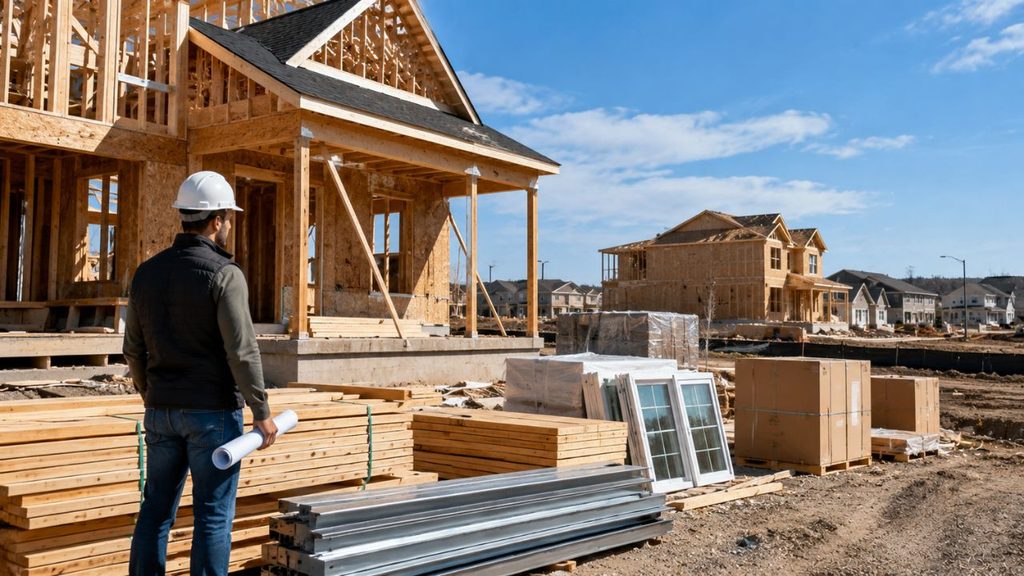
Canada’s retaliation includes tariffs on products such as steel, aluminum derivatives and appliances. Those are exactly the kinds of costs that can eventually work their way into construction and renovation budgets.
If builders face higher material costs, they may have to charge more for new homes or delay projects that no longer make financial sense. That matters beyond the new-build market. Canada already needs more housing. If higher costs result in fewer homes being built, that can limit supply and eventually support prices in the resale market as well.
Could mortgage rates come down?

A weaker economy also puts interest rates back into the conversation. Earlier this summer, BMO suggested that worsening trade relations could reopen the door to Bank of Canada rate cuts if tariffs caused enough economic damage.
That doesn’t guarantee lower mortgage rates. Fixed mortgage rates are heavily influenced by bond yields, while the Bank of Canada has to balance slower growth against any inflation created by tariffs.
In other words, tariffs could simultaneously weaken the economy and make some things more expensive. That’s an awkward combination for the Bank.
Should first-time buyers wait?

I wouldn’t make a home-buying decision based on trying to predict how this trade dispute ends. The more useful question is whether the numbers work for you today.
If tariffs cool demand, buyers could find less competition and more negotiating room. If borrowing costs eventually fall, affordability could improve further. But if construction becomes more expensive and housing supply remains tight, waiting doesn’t necessarily mean homes will become cheaper.
For first-time buyers, this may be a market where patience helps—but being prepared matters even more. Having your financing reviewed early means you’re ready to act if the right property appears and the market temporarily shifts in your favour. Connect with us for free a personalized home buying plan.
How an Alberta mortgage broker helps when the outlook is this uncertain
Nobody gets paid to predict tariffs correctly. What we can do is make sure a shifting market finds you ready instead of guessing:
- We get your financing reviewed and pre-approved early, so a temporary shift in your favour is something you can act on rather than watch.
- We show you what you qualify for across multiple lenders — banks, monolines and alternative lenders all read a wobbly economy differently.
- We put a real monthly payment beside each scenario so “should I wait?” becomes a number instead of a feeling.
- We walk you through fixed versus variable in light of how fixed rates follow bond yields and variable follows the Bank of Canada — two different bets on the same news.
- We compare a new build against a resale home if rising material costs are changing the math on the neighbourhoods you are shopping.
- We build in a margin for job uncertainty, because the payment has to still work on a normal month, not just a good one.
Wondering whether the numbers work for you today?
Get your financing reviewed now, so you are ready to move if the market shifts in your favour — and know exactly where you stand if it doesn’t.
Apply Online → Book a Discovery Call → Serving Calgary, Edmonton & all of Alberta · Mortgages for Less with INDI MortgageTariffs and the housing market: common questions
What exactly did the U.S. and Canada announce?
Could tariffs push Canada back into a recession?
Would a weaker economy make homes cheaper for first-time buyers?
How could tariffs make new homes more expensive?
Does that affect resale homes too, or just new builds?
Will mortgage rates come down because of the trade dispute?
Should a first-time buyer wait to see how this plays out?
This article is general information for Alberta homebuyers, not financial, mortgage, tax or legal advice. Trade policy, tariff schedules, economic forecasts, bond yields and mortgage rates change frequently, and any mortgage is subject to lender approval. Please speak with a licensed mortgage professional about your specific circumstances. Mortgages for Less with INDI Mortgage.