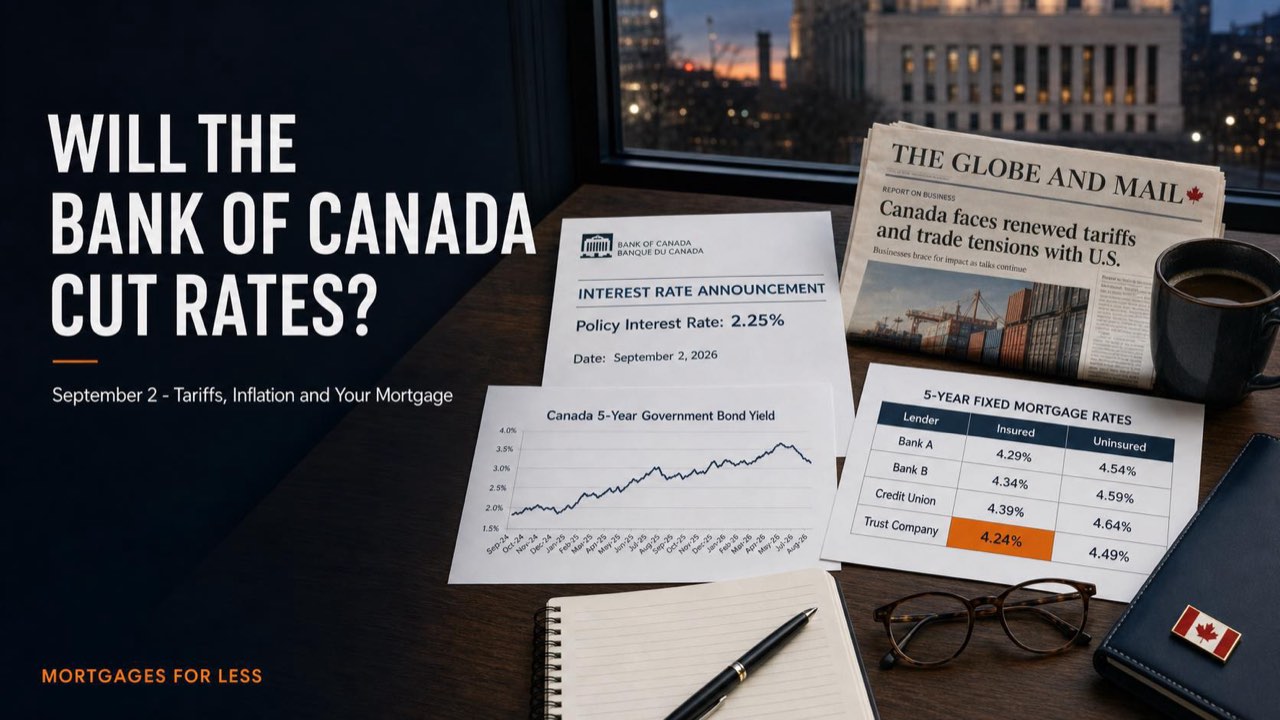
At 11:26 on Friday night, Mark Carney suspended trade negotiations with the United States. Thirty-four minutes later — 12:01 a.m. Saturday — 50% American tariffs went live on about $28 billion of Canadian goods. On September 8, Canada hits back dollar for dollar.
The Bank of Canada meets on September 2. That is six days before our own tariffs take effect, and eleven days after the American ones did.
So the question every renewing homeowner is asking me this week is a fair one: does any of this get you a rate cut?
One note before we start: Canada’s second-quarter GDP figures land on Friday, August 28 — the last major piece of data the Bank sees before it decides. We’ll update this article with the number and what it changes.
What did the United States actually just do?
The headline number is 50%, and it is real. But the shape of it matters more than the size.
The tariffs cover roughly $28 billion in Canadian goods — about 5% of what we ship to the United States. Plywood and paper, liquor, cement, dairy, electrical equipment, chemicals, plastics, industrial gear, hockey sticks. Energy, potash, critical minerals and fish are all exempt, and so is anything already caught by the earlier steel, aluminum, copper, lumber and auto tariffs.
BMO puts the direct hit at about 0.8% of GDP by export value. RBC, measuring the part that is actually Canadian value-added rather than pass-through, puts it closer to 0.4%. TD Economics figures it shaves 0.3 to 0.6 percentage points off growth over the next year, and expects the low end.
That is not nothing. In the targeted sectors it is brutal — RBC estimates up to 20% of production in apparel, textiles and electrical equipment is exposed, and Canadian iron and steel exports are already down roughly half from pre-tariff levels. But it is not an economy-wide shock, and it is important to be honest about that before we start throwing around words like stagflation.
Two things about this round are genuinely new.
First, it breaks the CUSMA firewall. Until Saturday, goods that complied with the Canada-United States-Mexico Agreement were tariff-free unless a specific sectoral measure caught them. These tariffs apply regardless. That is the precedent, and that is what the bond market reacted to.
Second, the legal plumbing has changed. The Supreme Court struck down Trump’s sweeping global tariffs back in February. Everything since has been assembled from older, narrower authorities — Section 232 for steel and autos, Section 122 for a 10% catch-all, and now Section 338 of the Tariff Act of 1930, a Depression-era provision that had never been used before in its 96-year existence. A patchwork built from odd corners of statute is harder to negotiate away than one big executive order.
The average effective U.S. tariff on Canadian goods goes from about 5.3% to about 7.6%.
Is this stagflation?
Stagflation means inflation broadening while the economy shrinks. It is the one combination that leaves a central bank with no good move, because the single tool it has — the policy rate — pushes both problems in opposite directions.
It is the right thing to worry about. It is also, right now, the wrong word. Here is what the data actually says.
Inflation is narrow, not broad. Headline CPI hit 3.0% in July. Strip out gasoline and it is 2.2%, and it has been 2.2% for three months running. The Bank’s two preferred core measures — CPI-trim and CPI-median — came in at 1.9% and 2.0%. Those are at or below the 2% target. Gasoline alone is running at +25.7% year over year, driven by the war in the Middle East and the on-again, off-again closure of the Strait of Hormuz. That is a supply shock in one line item, not an inflation problem in the economy.
Shelter is doing the opposite of what you’d expect. Shelter inflation is 1.3%. Mortgage interest costs are actually negative year over year. Rent is up 2.5% nationally and only 1.4% in Alberta. The reason is the most under-discussed number in Canadian economics right now: the population is shrinking. Canada lost 55,025 people in the first quarter of 2026. The Parliamentary Budget Officer expects roughly zero population growth this year, the second year in a row. The Bank of Canada explicitly credited weaker population growth for cooling rent inflation in its own July minutes.
And the economy is not stagnating. It was — the fourth quarter of 2025 and the first quarter of 2026 were both negative, which is a technical recession by the usual definition. But the second quarter looks like it grew at roughly 3% annualized. Unemployment has fallen from 7.1% last September to 6.4% in July, and the economy added 75,000 jobs in that month alone.
Inflation is narrow and cooling underneath. Growth is accelerating. Jobs are being created. That is not stagflation. That is an oil price problem sitting on top of a recovering economy.
The four gates
What would make it stagflation is a specific sequence, and it is worth naming so you can watch for it:
- Oil stays elevated long enough to spread. The Bank said it will look through higher gasoline prices — but added that “the longer oil prices remain elevated, the bigger the risk that their inflationary effects broaden.”
- Our own retaliation feeds through. On September 8 Canada puts tariffs on American steel, dairy, appliances, agricultural equipment, pulp and paper, and electronics. That is, mechanically, Canada choosing to raise its own consumer prices. Whatever you think of it as strategy, it is not disinflationary.
- The loonie keeps sliding. It fell 0.7% to 1.3851 on the news, the worst day among major currencies. A weaker dollar imports inflation on everything priced in U.S. dollars, which is most things.
- Expectations drift. The Bank’s July minutes record that “some members were concerned about signs of upward drift in medium-term inflation expectations.” Its own Business Outlook Survey has firms expecting 2.5% to 3%.
If all four fire together, the Bank of Canada’s own doctrine says it responds by raising rates into a slowing economy. That is the genuinely bad outcome, and almost nobody is positioned for it.
If they don’t — and today’s data says they haven’t — then tariffs are a demand shock with a one-time price bump attached, and the door opens to cuts in 2027 rather than 2026.
Why is Alberta’s inflation 4.2% when Canada’s is 3.0%?
This is the part that gets lost when the national number leads the news, and it matters a lot depending on where you live.
| Region | Inflation rate |
|---|---|
| Calgary | 4.2% |
| Alberta | 4.2% |
| Edmonton | 4.0% |
| Canada | 3.0% |
| Ontario | 2.0% |
| Toronto | 1.7% |
An Albertan and a Torontonian are living in inflation environments more than two and a half percentage points apart, and both of them are being governed by one policy rate set for the 3.0% average that neither of them experiences.
The easy explanation is gasoline, and gas is part of it — Alberta pump prices are up 28.3% versus 25.7% nationally. But it is not the whole story. Strip gasoline out entirely and Alberta is still running at 3.4% against a national 2.2%. Alberta services inflation is 4.2% versus 2.5% nationally. Groceries are 4.1% against 3.1%. Natural gas is up 6.3% in Alberta while it fell 7.5% across the country.
There is a real, non-gasoline inflation problem in Alberta, and it is not going to be solved by a Bank of Canada looking at a national core reading of 1.9%.
The flip side is the housing market. Calgary’s benchmark price was $569,200 in July, down 2.0% year over year, with 6,626 active listings and about 3.5 months of supply. Edmonton’s residential median sat at $417,750. Prices are soft in both cities. If you are carrying a mortgage in Alberta, your cost of living is climbing faster than the national average while your home equity is going the other way. That is a squeeze worth planning around rather than hoping through, and it is one of the first things we look at on an Alberta mortgage renewal.
What has the Bank of Canada already told us it will do?
The most useful document available isn’t a forecast. It’s the summary of what the Governing Council actually argued about on July 15, published two weeks later.
They held at 2.25%. They said the “trade-off facing monetary policy had diminished” — meaning they’d become more confident growth would strengthen in the back half of the year. But the confidence wasn’t unanimous: “there was a range of views among Governing Council members about the sustainability of the rebound beyond the near term.”
Three lines from that document tell you almost everything about September 2.
On oil: they will look through it, unless it lasts. “If oil prices increased and were to stay higher, spillovers to other prices could increase… Such a scenario would likely require a monetary policy response.” Read that carefully. The response they are contemplating is a hike.
On the labour market: it “remained soft,” with a flagged risk that “resilience in consumer spending could wane if labour market conditions remain soft and hiring does not pick up.” That is the dovish case, and it is currently being contradicted by 75,000 jobs in a month.
On expectations: some members are watching “signs of upward drift in medium-term inflation expectations,” though all agreed the long-term anchor is holding.
And behind all of it sits Governor Macklem’s position on trade shocks, which he laid out in 2025 and has not moved from:
That is the whole answer to “will tariffs force a rate cut,” and the Bank published it eighteen months ago. A tariff destroys supply. Rate cuts do not create supply. The Bank will only cut if the tariff destroys enough demand to open up real economic slack — and that takes quarters of data, not eleven days.
One more piece of context that gets skipped: the Bank estimates its own neutral rate — the level that neither stimulates nor restrains — at 2.25% to 3.25%. The policy rate is sitting at the very bottom of that range. By the Bank’s own arithmetic, it is already giving the economy the mildest push it can give without formally easing.
What are the big banks forecasting?
As of the most recent published round, here is where the Big Six sat:
| Bank | End of 2026 | 2027 |
|---|---|---|
| TD | 2.25% | 2.25% all year |
| BMO | 2.25% | 2.25% all year |
| CIBC | 2.25% | Hikes from Q2, 2.75% by Q3 |
| National Bank | 2.25% | 2.50% Q1, 2.75% Q2 |
| RBC | 2.25% | 2.50% Q1, rising to 3.25% |
| Scotiabank | 2.75% by Q4 | 3.00% early 2027 |
Look at that column on the right. Not one of the six forecasts a rate cut. Every next move on the board is either a hike or nothing at all. Through the entire summer of 2026, the debate among Canadian economists has been about when the Bank starts raising, not whether it will cut.
TD Securities, writing after the talks collapsed, still expects a hold on September 2, a hold through the rest of 2026, and then quarter-point increases in January and March of 2027.
The most interesting call is BMO’s. Robert Kavcic wrote in July that the Bank is “firmly on hold” and that any rate increase would now have to be considered “very, very carefully” — but that if Canada-U.S. trade relations deteriorated, the resulting damage could “open the door to easing again.” He wrote that a month before the deal fell apart. That scenario is now live, and it is the single clearest path to a cut that exists.
The dissenting voice worth listening to is Rob McLister’s. His point is that gasoline is exactly the kind of shock central banks are trained to look through, but that “a supply shock that runs long enough stops being look-through-able” — and that a comfortable consensus is comfortable right up until it isn’t. That is a fair warning about a room full of forecasters who all agree.
So — September 2, or October 28?
September 2 is a hold. I’d put it above 95%.
Walk into the room with them. On the table: second-quarter GDP that likely grew around 3%, headline inflation at 3.0%, core inflation at 1.9%, unemployment falling for a fourth straight month, and a trade shock that is less than two weeks old with no data behind it whatsoever. There is no Monetary Policy Report at this meeting and no new forecast. Cutting into a strong GDP print with headline inflation at 3% would be very hard to explain, and the Bank knows it.
What you should watch for instead is language. Does the statement name Section 338 directly? Does “risks are two-sided” survive, or does the growth risk get top billing? Does the phrase “prepared to adjust monetary policy as needed” get sharpened? That is where the September signal lives.
October 28 is the meeting that matters. By then the Bank will have August and September inflation, two more jobs reports, third-quarter tracking, Canada’s retaliatory tariffs actually in force for seven weeks, and a fresh Monetary Policy Report with new tariff scenarios. A hold is still the base case. But October is the first meeting since 2025 where a cut is a genuinely arguable position rather than a fringe one.
The honest framing for the rest of 2026 is that the Bank is pinned. Headline inflation is too high to cut. Growth is too decent to cut. Core inflation is too low to hike. Trade risk is too large to hike. Nothing moves until one of those four constraints breaks.
What does this mean for your mortgage right now?
Here is the part that surprises people, and it is the most useful thing in this article.
Bad news for the economy is good news for fixed mortgage rates.
Last Friday, August 21, the five-year Government of Canada bond yield touched 3.36% — its highest level in twelve months. For reference, it bottomed at 2.62% last October. Lenders responded exactly as you’d expect and pushed fixed rates up 10 to 20 basis points across three-, four- and five-year terms.
Then the trade talks collapsed, and the five-year yield fell to 3.28%, and to 3.22% by August 25. Bond investors read a trade war as slower growth and less chance of future rate hikes, so they buy bonds, and yields drop. Your fixed mortgage rate is priced off that yield, not off the Bank of Canada’s overnight rate — which is the single most useful thing to understand about what actually controls your mortgage rate.
Which brings up the second thing worth understanding: the main driver of your fixed rate right now isn’t in Ottawa at all. It’s the global long-bond market. U.S. federal debt passed $40 trillion this month. The 30-year U.S. Treasury hit 5.34%, its highest since 2007. The U.S. Treasury is doubling the size of its bond buybacks starting September 9 to try to calm things down. Canada’s five-year yield follows the U.S. long end closely, and that is what has been pushing your fixed options higher all summer while the Bank of Canada hasn’t moved a basis point since October.
And that has flipped the fixed-versus-variable math. With prime at 4.45% and the policy rate frozen while bond yields climbed, a good five-year variable is currently pricing around prime minus 0.80% — roughly 3.65% — against the cheapest insured five-year fixed on our board at 4.09% — an ATB product for purchases and straight switches, carrying a six-month rate hold and unchanged since July 21. That is a gap of about 44 basis points in favour of variable.
That gap is real money and it is also a real risk, and reasonable people disagree about it. Bruno Valko at RMG argues the discount is wide enough to absorb three quarter-point hikes before variable loses. Measured against the cheapest fixed on our board, that math is tighter: a 44-basis-point spread absorbs fewer than two quarter-point hikes, and after the second one the fixed payment is already the cheaper of the two. Ron Butler takes the other side: “the potential for Bank of Canada rate increases in 2027 is real,” and his advice is that if you see a fixed rate below 4.19%, take it. At 4.09%, that one is no longer hypothetical.
They’re both right, because they’re answering different questions. Variable pays you today and gives you a free option on the trade war doing damage — the same collapse that hurts the economy is the thing that would cut your rate. Fixed costs you 44 basis points a month for certainty, and protects you against the one scenario nobody’s pricing, which is oil staying high long enough that the Bank hikes into a downturn.
The right answer depends on your amortization, your renewal date, your cash flow cushion and how much a payment increase would actually change your life. There is no universal answer, and anyone giving you one without asking those questions is selling, not advising. If you want the long version of that argument, I wrote it out in what I’m telling my clients about fixed versus variable.
One practical note if you’re renewing in the next six months: get a rate hold in place now. Holds are free, they protect you from the next bond selloff, and you keep the benefit if rates fall. In a market that moved 74 basis points in ten months and just absorbed a trade war, there is no argument for going unhedged.
How an Alberta mortgage broker helps when rates are this unsettled
Nobody can tell you what the Bank of Canada does on September 2 with certainty. What we can do is make sure the decision doesn’t catch you unprepared:
- We model your renewal at three rate scenarios, not one, so you know what actually breaks your budget.
- We lock a rate hold today at no cost — and you keep the benefit if rates fall before you close.
- We run the real fixed-versus-variable math on your balance and amortization, not a generic rule of thumb.
- We compare a straight switch against staying put, including your current lender’s penalty math.
- We check whether a shorter term bridges you past the trade-war noise more cheaply than five years.
- We show you the actual bond-yield trend behind every rate quote, so you know what you’re deciding on.
Renewing or buying while all this plays out? Let’s run your numbers.
Whether you’re renewing in the next six months or shopping for your first home, we’ll show you what each scenario actually costs you per month — and lock a rate hold while you decide. Start online or book a quick call.
Apply Online → Book a Discovery Call → Serving Calgary, Edmonton & all of Alberta · Mortgages for Less with INDI MortgageBank of Canada, tariffs and your mortgage: common questions
Will the Bank of Canada cut rates on September 2, 2026?
Do Trump’s tariffs make a Bank of Canada rate cut more likely?
Is Canada heading into stagflation?
Why is inflation so much higher in Alberta than in Ontario?
Will fixed mortgage rates go down because of the trade war?
Should I take a fixed or variable rate right now?
When is the next Bank of Canada rate decision after September 2?
This article is general information for Alberta and Ontario homebuyers and homeowners, not financial, mortgage, tax, investment or legal advice. Economic data, forecasts and mortgage rates quoted are current as of August 26, 2026 and change frequently. Rates shown are illustrative, subject to lender approval, qualification and product availability, and are not an offer of credit. Please speak with a licensed mortgage professional about your specific circumstances. Mortgages for Less with INDI Mortgage.