
By Josh Tagg, mortgage broker · Mortgages for Less with INDI Mortgage · Calgary, serving all of Alberta ·
One of the easiest ways to save money on your mortgage is to pay it off faster.
Most Canadian mortgages include prepayment privileges that allow homeowners to put extra money toward their mortgage principal without paying a penalty. The more principal you pay off early, the less interest you’ll pay over the life of your mortgage.
The challenge is that every lender has different rules regarding how much extra you can pay and how often you can make those payments.
What are the two ways to pay down your mortgage faster?
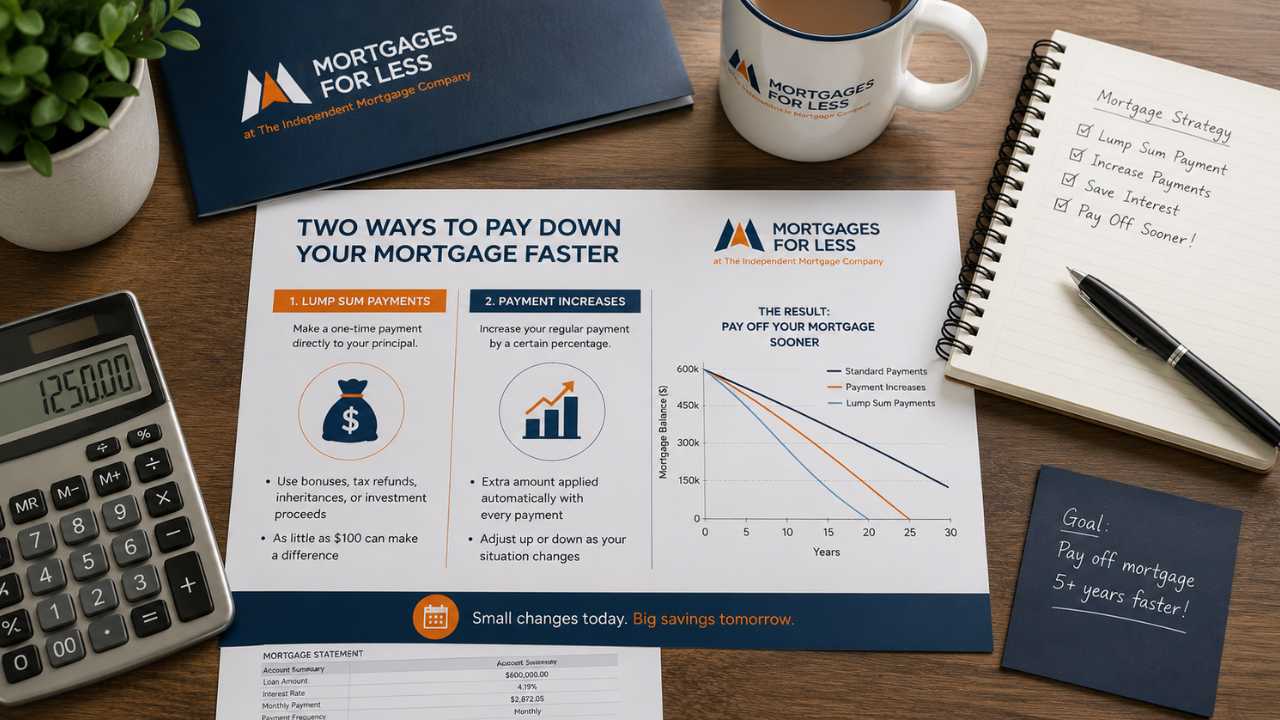
Most lenders offer two main ways to accelerate your mortgage repayment:
1. Lump Sum Payments
A lump sum payment is a one-time payment applied directly to your mortgage principal.
Many homeowners use bonuses, commissions, tax refunds, inheritances, or investment proceeds to make lump sum payments. These can be as little as $100.
2. Payment Increases
Most lenders also allow borrowers to increase their regular mortgage payment by a certain percentage. This can be a simple way to pay down your mortgage faster because the extra amount is automatically applied with every payment. And if you ever need to bring that payment back down again, you can (to a minimum of the originally agreed amount.)
Importantly, payment increases and lump sum privileges are usually separate benefits. In most cases, increasing your monthly payment does not reduce the amount you’re allowed to contribute through lump sum payments.
How do the major lenders compare?
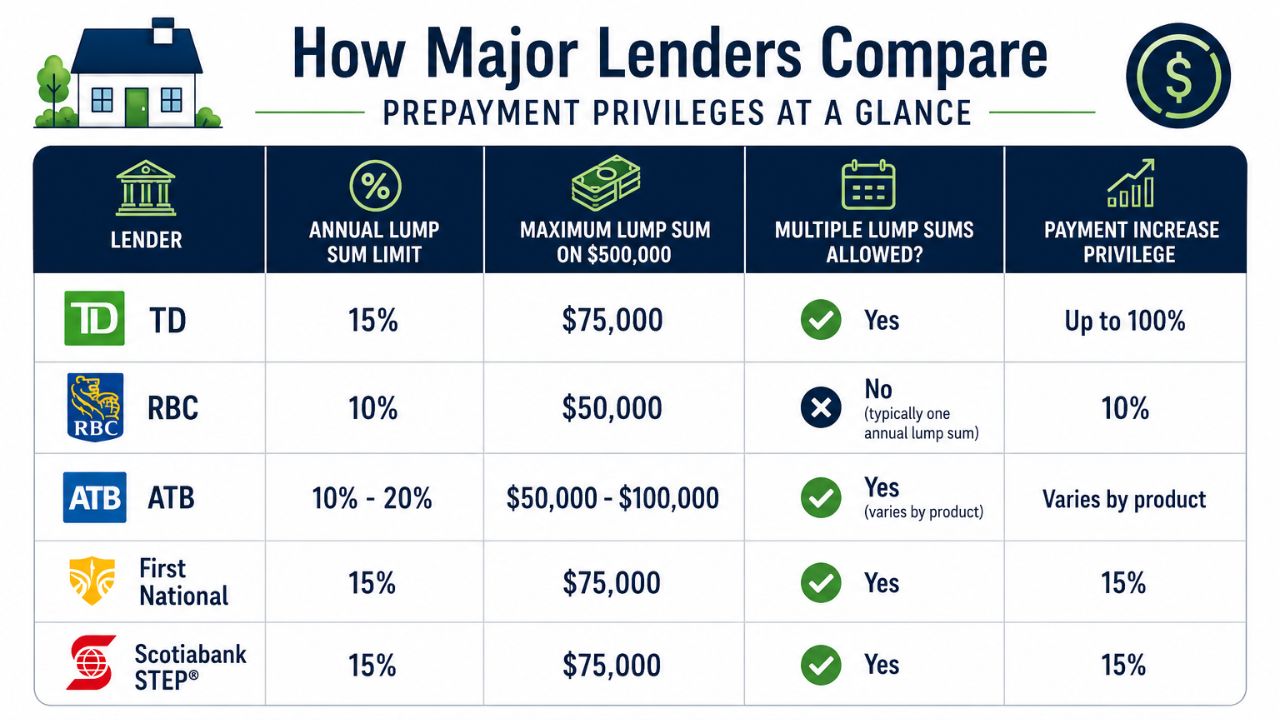
Here’s a comparison of common prepayment privileges offered by several major lenders.
| Lender | Annual lump sum limit | Maximum lump sum on $500,000 | Multiple lump sums allowed? | Payment increase privilege |
|---|---|---|---|---|
| TD | 15% | $75,000 | Yes | Up to 100% |
| RBC | 10% | $50,000 | No (typically one annual lump sum) | 10% |
| ATB | 10% – 20% | $50,000 – $100,000 | Yes (varies by product) | Varies by product |
| First National | 15% | $75,000 | Yes | 15% |
| Scotiabank STEP® | 15% | $75,000 | Yes | 15% |
How powerful is increasing your payment amount?
Lump sum payments tend to get most of the attention, but payment increases can be just as powerful.
Let’s say your mortgage payment is $2,500 per month. If your lender allows a 15% payment increase, you could raise your payment to $2,875 per month. That would direct an additional $4,500 toward your mortgage every year without having to plan a lump sum payment.
TD stands out in this category because it allows payment increases of up to 100% of the original payment amount on many mortgage products.
Which strategy is better: lump sums or payment increases?
The answer depends on how you get paid. If you receive bonuses, commissions, or other irregular income, lump sum payments may make the most sense. If your income has increased permanently and you want a simple set-it-and-forget-it approach, increasing your regular mortgage payment may be the better option.
Many homeowners use both strategies together. For example, someone might increase their monthly payment after receiving a raise while also applying annual bonuses as lump sum payments.
What should homeowners take away from this?

Most borrowers focus on interest rates when comparing mortgages. However, prepayment privileges can have a significant impact on how quickly you become mortgage-free.
Before signing a mortgage, take a few minutes to understand:
- How much you can contribute through lump sum payments
- Whether multiple lump sums are allowed
- How much you can increase your regular payment
- Whether those privileges are separate from one another
The answers vary by lender, and those differences can have a meaningful impact on your ability to pay down your mortgage faster. To get started on your mortgage journey, contact me.
How an Alberta mortgage broker helps you compare prepayment privileges
Rate comparison is easy to do yourself. Prepayment terms are buried in the commitment, and that’s where a broker earns their keep:
- We read the prepayment clause before you sign, not after — it is one of the few mortgage features you cannot renegotiate later.
- We check whether the lump sum and payment increase privileges are separate or shared, because a lender that stacks them is worth more than a headline rate.
- We flag whether multiple lump sums are allowed, or whether you get one window a year and have to time it.
- We match the privilege to how you actually get paid — bonus and commission income needs lump sum room, a permanent raise needs payment increase room.
- We weigh a slightly better rate against weaker prepayment terms, so you can see what the cheaper rate is really costing you.
- We shop banks and monoline lenders together, which is the only way to see the full range from 10% to 100%.
Want to know what your mortgage actually lets you prepay?
Send us your current mortgage or the one you’re being offered and we’ll tell you exactly what you can pay down, how often, and what it would save you.
Apply Online → Book a Discovery Call → Serving Calgary, Edmonton & all of Alberta · Mortgages for Less with INDI MortgageMortgage prepayment privileges: common questions
What is a mortgage prepayment privilege?
What is a lump sum mortgage payment?
How much can I increase my regular mortgage payment?
Does increasing my payment reduce my lump sum limit?
How much is a lump sum privilege worth on a $500,000 mortgage?
Which is better, a lump sum or a payment increase?
What should I check before signing a mortgage?
This article is general information for Alberta borrowers, not financial, mortgage or legal advice. The lender prepayment privileges described above reflect common terms at the time of writing; they vary by mortgage product, can differ between insured and uninsured mortgages, and are set out in your own mortgage commitment and loan agreement, which governs. Lender criteria and mortgage terms change without notice. Please confirm your own privileges with your lender or speak with a licensed mortgage professional. Mortgages for Less with INDI Mortgage.