
When people hear the term “B lender,” they sometimes assume it means a sketchy lender operating from the back of a van.
Thankfully, that is not what it means.
B lenders are established financial institutions that offer mortgages to borrowers who do not fit the strict approval rules used by traditional banks and other prime lenders. They can be a useful option for Alberta homebuyers, homeowners and real estate investors whose finances are perfectly reasonable but slightly more complicated than a standard mortgage application allows.
How Is a B Lender Different From a Bank?

Traditional banks and other prime lenders are often called A lenders. They usually offer the lowest mortgage rates, but borrowers must meet fairly rigid requirements.
A lenders generally prefer applicants with strong credit, predictable income, manageable debt and easily documented employment. In other words, they like mortgage applications that fit neatly into a spreadsheet without causing the underwriter to reach for extra coffee.
B lenders have more flexible guidelines. They may be willing to consider the overall strength of the application rather than rejecting it because one detail falls outside the usual box.
Who Might Use a B Lender?
A B lender mortgage may be appropriate for someone who:
- Is self-employed and reports significant business expenses
- Has recently started a new business or changed careers
- Has bruised credit from a past financial setback
- Owns several rental properties
- Has income that is difficult to verify using standard documents
- Has a higher debt-to-income ratio
- Needs more flexibility with the property or down payment
For example, a successful Alberta contractor may earn excellent income but reduce taxable income through legitimate business deductions. A traditional lender may only look at the income shown on the tax return. A B lender may consider bank statements, business revenue and other supporting documents.
Do B Lenders Charge Higher Rates?
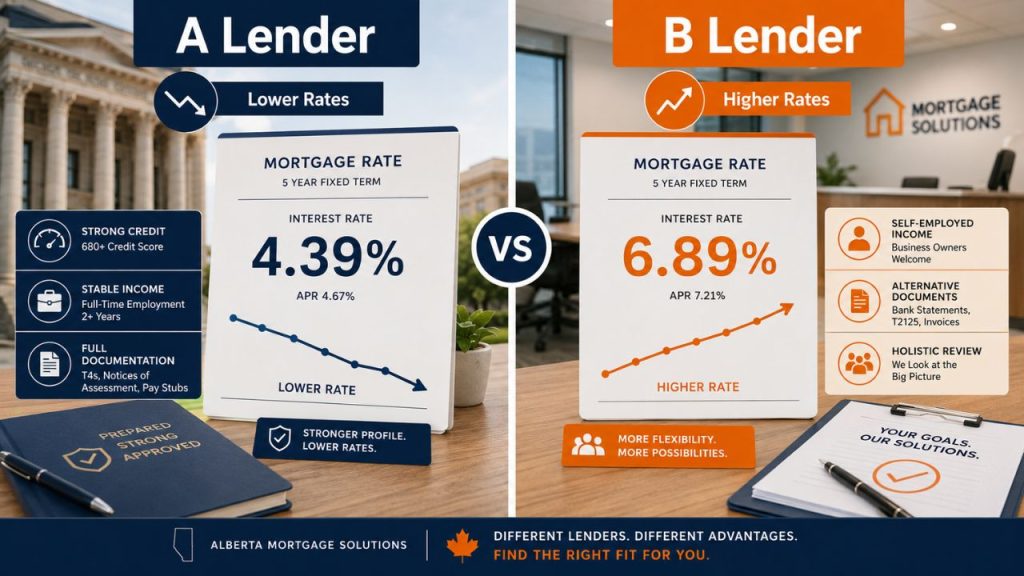
Usually, yes.
Because B lenders accept applications with additional risk or complexity, their mortgage rates are generally higher than prime lender rates. There may also be lender fees, appraisal costs and additional legal expenses.
The exact cost depends on the borrower, the property, the amount of equity and the reason the B lender is required.
This does not automatically make a B mortgage a bad decision. The important question is whether the mortgage solves a problem and helps the borrower move toward a stronger financial position.
Are B Lenders the Same as Private Lenders?
No. B lenders and private lenders are different categories.
B lenders are usually regulated financial institutions with established lending policies. Private lenders are individuals or mortgage investment companies that focus primarily on the property’s value and available equity.
Private mortgages are normally more expensive and are often used for short-term or urgent situations. A B lender generally sits between a traditional bank and a private lender.
Is a B Mortgage Permanent?

It does not have to be.
Many borrowers use a B lender as a temporary stepping stone. During the mortgage term, they may improve their credit, establish a longer self-employment history, reduce debt or organize their financial documents.
The goal may be to move back to an A lender at renewal. That is why the exit strategy matters just as much as the initial approval.
A B lender is not a punishment or a financial scarlet letter. It is simply another lending option. For the right borrower, it can provide enough flexibility to purchase a home, refinance debt or hold onto a property while improving their financial situation.
How an Alberta mortgage broker helps with a B lender mortgage
Banks decline. Brokers place. Here’s what actually happens on a B file:
- We work out whether you genuinely need a B lender, or whether a different prime lender reads your income the way you’d hope.
- We present self-employed income properly — bank statements, business revenue and supporting documents, not just the number on the tax return.
- We price the total cost, not just the rate: lender fees, appraisal and additional legal expenses included, so you can compare offers honestly.
- We match the file to the right tier — A, B or private — instead of defaulting to whichever one says yes first.
- We build the exit strategy into the term: what needs to change in your credit, documentation or debt for an A lender to take you at renewal.
- We stay in touch before the renewal date so the move back to prime is planned, not rushed.
Been told your file is too complicated?
Self-employed, bruised credit, several rentals, or income that’s hard to document — let’s look at what you actually qualify for and what it costs.
Apply Online → Book a Discovery Call → Serving Calgary, Edmonton & all of Alberta · Mortgages for Less with INDI MortgageB lender mortgages in Alberta: common questions
What is a B lender?
How is a B lender different from a bank?
Who might use a B lender?
Do B lenders charge higher rates?
Are B lenders the same as private lenders?
Is a B lender mortgage permanent?
Does using a B lender mean something went wrong?
This article is general information for Alberta homebuyers and homeowners, not financial, mortgage, tax or legal advice. Lender categories, guidelines, rates and fees vary by lender and change over time, and every mortgage is subject to lender approval. Please speak with a licensed mortgage professional about your specific circumstances. Mortgages for Less with INDI Mortgage.